How to Scale Your Content Program (Without Sacrificing Quality)
Learn how leading marketers scale content programs with clear workflows and benchmarks without losing quality or creativity.




I’m old enough to remember when the first Starbucks opened in the UK.
I was (I hasten to add) a young teenager when I trotted down the King’s Road to check out the brand-new, impossibly shiny café. It was unlike anything else in London. The flavored coffees! The oversized armchairs! The comically large mugs! It felt a little special. Unique.
Today, there are over 1,100 Starbucks in the UK alone. You can grab a pumpkin spice latte at Heathrow at 5 a.m. We’ve both gotten older. And let’s be honest — we both look a little more… weathered.
Starbucks went from being an indulgent, slightly fancy place to drink overpriced coffee to being, well… Starbucks. Omnipresent. Standardized. Perfectly fine, if you like that sort of thing — but not exactly where you’d go for a truly exceptional coffee.
For content marketers, scaling up can feel like the same risk. The more content you produce, the easier it is to trade uniqueness for efficiency. To go from artisanal to assembly line.
So, how do you grow without losing what makes your content special?
I asked content experts who’ve done exactly that. Here’s what they had to say:
Start by fixing the foundation
Scaling doesn’t (just) mean more output. Successful scaling requires scalable systems: defined roles, reusable templates, automated workflows, and shared tracking—not just more people or assets.
To quote Tommy Walker, founder of The Content Studio:
“Early in my career, “content strategy” = “what we were going to publish”
Now it’s:
‘What are we going to publish?’
‘Where are we going to publish it?’
‘How will we validate big bets?’
‘How will we manage production?’
‘When will it pay off?’
‘How do we scale it if it is successful?’
Before you start to ramp up production, it’s worth asking: Can our systems even support more content? Without a solid foundation, even the best content strategy will start to wobble under pressure.
That’s where tools like Relato can help — by centralizing requests, briefs, and approvals so scaling doesn’t turn into chaos management.
Define what “quality content” means for your team
If you want to maintain quality, you need to first agree what “quality” means for your team. As Tyler Hakes, Principal at Optimist, pointed out, “‘Quality’ is a terrible measurement because it’s subjective. Get clear on what that actually means in practice and what success looks like for the program and each individual project.”
To get a collective agreement on what quality looks like, you’ll need more than just a style guide. You’ll need to…
Establish a content benchmark
Content benchmarks aren’t style guides. Although those can be very helpful too, especially if you’re planning to outsource production. Rather, it’s a framework to quickly evaluate each piece of content against your agreed-upon definition of quality.
For instance, Fio Dossetto, Content Lead at Float, uses the EASY framework — a benchmark coined by Dossetto herself. EASY, Fio explains, stands for:
**Expert: **The content must include human expertise (such as input from internal or external SMEs or power users of your product).
**Actionable: **The content must give the reader advice they can actually use, not vague, intangible suggestions.
Simple: The content must be tightly edited, avoid jargon or idioms, be understandable by an international audience, and avoid tangents or fluff.
Yours: The content must be obviously written by your brand, unique, differentiated, and personalized.
For those with a very SEO-oriented content strategy, the Backlinko QRIES framework could be the right fit. QRIES is the approach the Backlinko team uses to make sure each piece of content meets Google’s E-E-A-T standards, and it stands for:
Quotes
Research
Images
Examples
Statistics
If you’re looking for a longer format for your benchmark, consider Tommy Walker’s Code. As he explains, the Code “is not a bland set of rules. It’s a manifesto that is written in the voice the brand plans to communicate across all media.”
The Code includes instructions for all content creators working for the Content Studio, a list which includes 10 content rules, with detailed explanations and examples. For example:
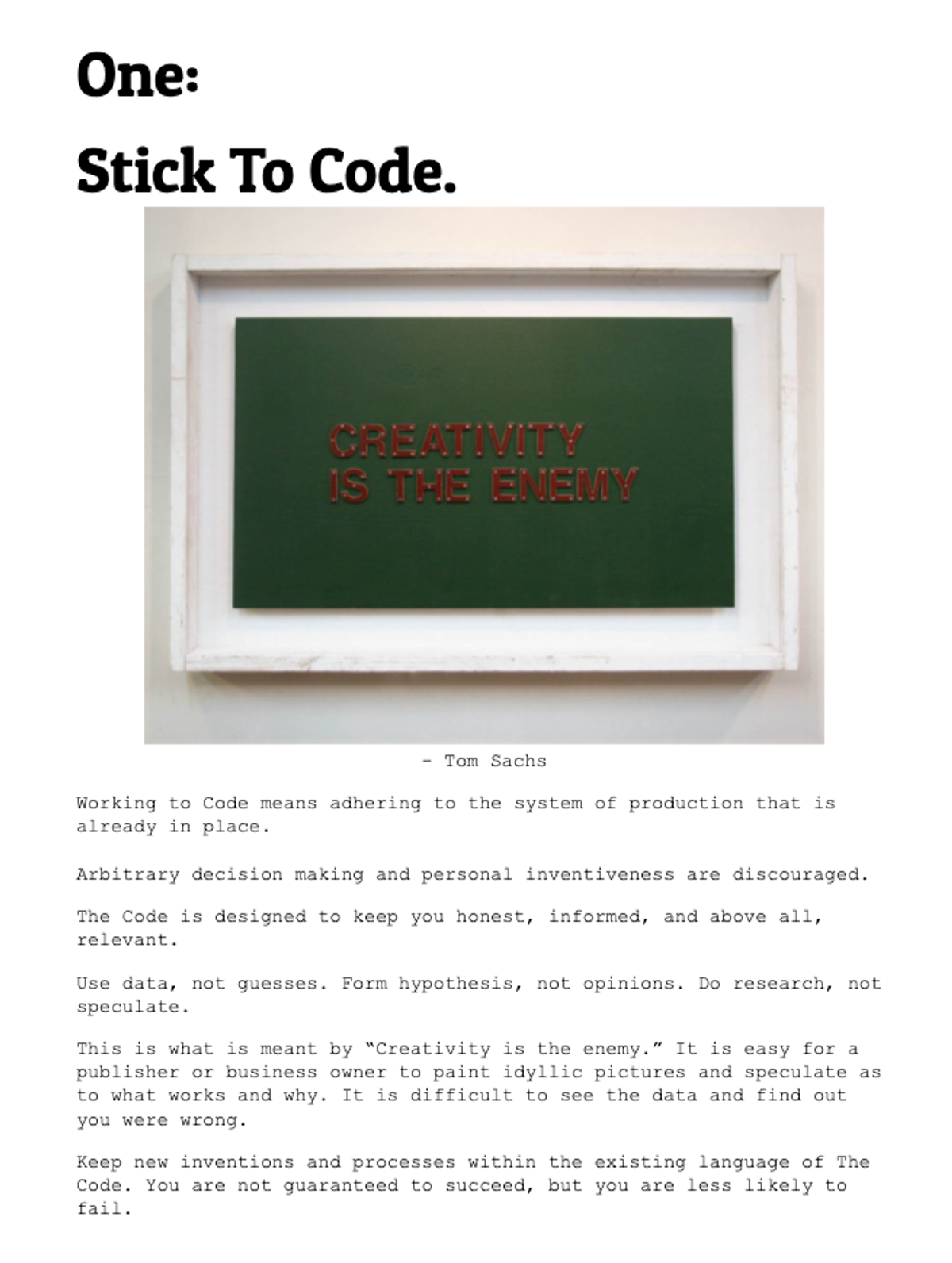
Rule 2. Don’t Paint Idyllic Pictures.
Rule 3. Don’t Talk Down To The Reader.
And, my personal favorite:
Rule 4. Opinions Are Bullshit. Do The Research.
“The Code,” explains Walker, “is designed to keep you honest, informed, and above all, relevant.”
Again, it’s not a style guide or a brand voice guide — it’s a rubric that lets you know if your content reaches the desired quality or not.
Get more out of every piece of content
Too many brands think of scaling up in terms of generating more net new content, says Dossetto. “Whereas the way I think about more content is, ‘How much juice can I squeeze out of an individual piece of content?’”
Fractional Content Marketing Consultant Lindsey Tague told me that, in her experience, net new content may actually decrease rather than increase as your content program matures.
“I’ve done a fair share of blog development from scratch these past few years. We typically start with a higher quantity of pieces, then scale down. By then we have enough to repurpose and continue to distribute in various ways across other channels.”
The quantity vs quality discussion is a false dichotomy. As Dossetto points out, “If your source material is good, then the atomization and the repurposing of it should also technically be good.”
If you’ve got a really solid 40-minute interview, podcast, or live session with experts or practitioners, you can pull tons of great clips and editorial content from it. Since you’re starting with such a strong foundation, it’s way less work than creating everything from zero.
Squeeze more value from every piece of content.
Relato helps teams repurpose, distribute, and track content across channels from a single workspace.
Standardize (and guard) your editorial workflow
You’ll never be able to create more content if you’re stuck in reactive mode, says Hakes.
“One big challenge for content teams, in my experience, is that there’s not enough thought put into an ‘idea’ before it gets added to the queue. This quickly creates overwhelm and kills the quality of the output.”
Instead, create a standardized editorial workflow that starts with a formal request process for new content.
Example of a step-by-step editorial workflow
Content request
Request approval
Content brief creation
SME consultation
Writer assignment
First draft submission
Internal review & editing
SME review for accuracy
Revisions
Final approval
Design and multimedia integration
Formatting and uploading
Quality assurance and proofreading
Publishing
Distribution and promotion
Repurposing
Performance tracking & analysis
Content updates and refreshes
**💡 **Note that we’ve baked SME involvement into the process (we’ve got a guide on exactly how to involve SMEs, if you need it).
It can also be helpful to create standardized repurposing processes, says Phillip Ruffini. For example, when scaling up content production for Rupa Health, Ruffini’s team created a few flywheels for how they’d repurpose their content
Podcast -> Instagram and Facebook posts
Magazine Articles -> Instagram and Facebook Posts
Posting YouTube -> LinkedIn/Twitter/Magazine articles
Don’t let your team become a bottleneck
Often, the biggest impediment to scaling up content is…well, you. Content is labor-intensive, especially if you have high standards for quality.
It can be tempting to throw more writers at the problem, but, as Hakes points out, this approach “just scales the headaches, creates a ton of cleanup work for the team, and also hurts the output.”
Instead, try:
**Building a solid network of skilled freelancers. **Barry Stingmore, the Head of Sales at SEO agency Eleven Writing, likes this approach because experienced freelancers “don’t need your supervision. They stop your in-house team from becoming a bottleneck, and can be scaled back down again easily.”
**Creating templates. **Dossetto’s team has a stash of branded templates that they can use to put together a LinkedIn carousel, quick video, and so on.
Using AI. AI can be a great tool for repurposing existing content, automating workflows, or running QA to make sure every piece of content lines up with your brand voice.
Scaling without compromise
Scaling content is always a balancing act: you want more reach without losing the quality that makes your work worth reading in the first place.
Relato is built to help you do exactly that. By putting requests, briefs, reviews, and repurposing in one trackable workflow, it’s the automation platform designed for content teams. This supports your growing output while keeping standards high.
Scale content without losing what makes it great.
Relato helps teams grow output while keeping quality, creativity, and brand voice intact.
FAQs
How do you scale content without losing quality?
You scale content without losing quality by first defining what “quality” actually means for your team, then creating benchmarks to measure against, and finally building workflows that enforce consistency. This way, every piece is held to the same standard, even as volume grows.
What benchmarks should I use to measure content quality?
Popular benchmarks include the EASY framework (Expert, Actionable, Simple, Yours) and the QRIES framework (Quotes, Research, Images, Examples, Statistics). You can also create your own rubric tailored to your brand. The key is to make the benchmark explicit so every contributor knows what “good” looks like.
Which workflows help teams scale effectively?
The most effective workflows are standardized editorial processes that cover the full lifecycle: content requests, brief creation, SME input, draft and review cycles, approvals, publishing, distribution, repurposing, and refreshes. Having this structure in place keeps scaling efficient and sustainable.
How does Relato support content scaling?
Relato supports scaling by giving teams a single place to manage requests, briefs, approvals, and repurposing. Instead of juggling tools, teams streamline operations and maintain quality while producing more.