The Dangers of Falling in Love with Your Own Content Ideas
Loving your own ideas can blind you to costly mistakes. Expert marketers share strategies to balance creativity with content your audience will love.




From 2006, LifeLock CEO Todd Davis set out to prove how effective his company’s security measures were by publishing his own social security number in their marketing, including on the side of a truck.
You’ll be amazed to hear that this was not a good idea.
Thieves took the advert at its word. They used Davis’ identity at least 13 times, according to reporting by the Phoenix New Times that Davis himself confirmed. Then in March 2010 the FTC and 35 state attorneys general settled with LifeLock for $12 million over deceptive advertising claims, $11 million to the FTC and $1 million to the states.
The detail usually gets mangled in the retelling. That $12 million was the company’s bill, not Davis’ personal one, and Davis says he never actually lost money to the thefts. The campaign cost him the one claim it was built to make.
But bad marketing ideas are not always so obviously bad. Sometimes, they look smart, fresh, fun.
And part of creating original content is taking the risk that not every piece is going to land with your readers.
So, how do you find the line between being imaginative and being strategic with your content?
Run every idea through the same three questions before it gets a budget. Does it map to a problem your ICP is actively trying to solve? Is it a topic you are genuinely positioned to own? Can you tie it back to your own point of view? An idea that clears all three is worth building. An idea that only clears “our team loves it” is a darling, and darlings are expensive.
We asked nine practitioners who make that call for a living:
Louis Grenier, founder of Stand The F*ck Out and former Content Manager at Hotjar
Sara Lattanzio, then Head of Marketing at Stryber
Ryan Law, Director of Content Marketing at Ahrefs
Trish Seidel, Director of Brand Content at Teal
Ashley Cummings, founder of Searchlight Content
Rielle Lee, Content Marketing Manager at Microsoft
Tyler Hakes, Strategy Director and Principal at Optimist
Rachel Bicha, Content Writer & SEO Consultant
Morgan Short, content strategist for B2B SaaS founders
Here’s how they do it.
Overindex on audience research
“Deciding what content to write all boils down to knowing your audience,” says Ashley Cummings. Without that deep understanding of what topics will land with your target market, you run the risk of creating beautiful content that nobody wants. For a closer look at how seasoned marketers actually build that understanding, see how expert content marketers do audience research.
That instinct is only as good as the evidence feeding it, which is why it pays to check your gut against several layers of data rather than one. For Trish Seidel, that knowledge alone can help you avoid the trap: “I truly believe if you know your ICP, then you shouldn’t need to “check” your ideas at all. If you know what they’re Googling, what they’re searching for, what they like on socials, then any instinct you have is probably the right one.”
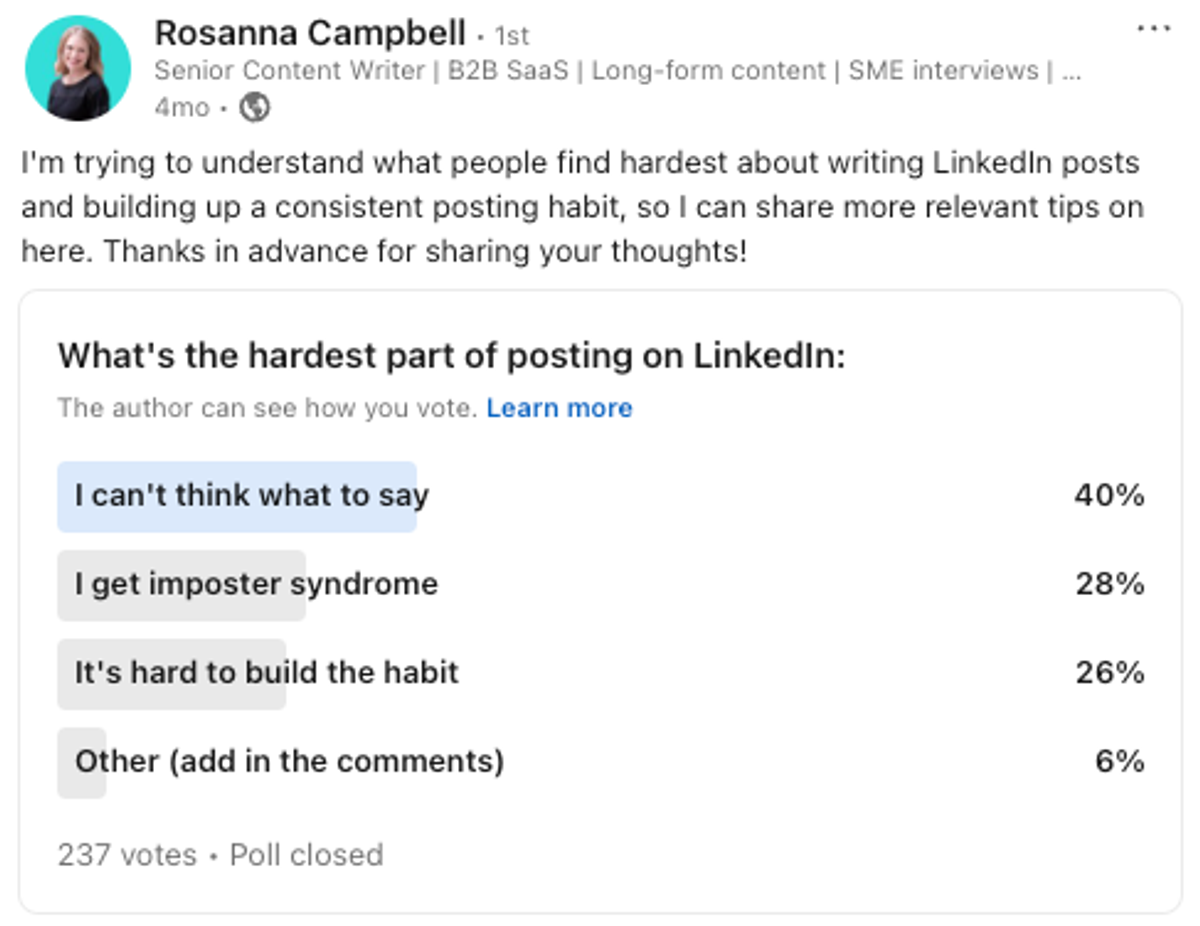
That said, if you are in any doubt, then our experts recommend running content ideas and approaches past your audience before going all in. If Rielle Lee and her team are working on a new content project, and feel unsure about content-audience fit, they “conduct new research surveys, poll our socials, and ask our customer advisory board to see if the topic is something that would actually be beneficial for them and what potential format would be easiest for them to consume it.”
But make sure you ask the right questions
Of course, that doesn’t mean simply going to your audience and saying, “What do you think about this content idea?” People are polite, and will tell you what you want to hear.
As Louis Grenier points out: “There’s always a balance, a tension between giving something that people want and doing something that lifts us. You don’t want to go too far in any direction because (1) People don’t really know what they want and (2) You don’t want to lose them either.”
Instead, Rielle suggests that you identify the pain points the topic speaks to, and ask your audience about their experiences around that pain point, how important it is to their processes, how much time, effort and resources they spend on it, and where they would look for solutions normally.
For instance, let’s say you’re creating a content series about sales coaching tools. Assuming you have a large, engaged audience, you could apply Rielle’s approach by identifying the core pain points and engaging your audience with a relevant LinkedIn post to check your assumptions before you get stuck into the series.
Here’s an example post to show you what we mean:
“How much time do you waste on admin, when you’d rather be coaching your reps?
Our data showed that most sales managers are spending 16 hours a week on data entry.
That’s a crazy waste of one of the most valuable assets your company has.
I’m curious, does this come up for you? Do you feel like you’re wasting time on admin? If someone waved a magic wand and gave that time back to you, what would you do with it?”
If the post gets high traction, it suggests that you’ve identified a pain point that resonates with your audience. The comments should give you some ideas of areas you should focus the content series on, and hopefully also a sense of the scale and severity of the problem.
In essence, take a leaf out of the product developers’ playbook. To quote Daniel Kyne, founder of research tool OpinionX, “We’re not really looking to “validate an idea” at all — instead, we’re trying to discover a high-priority problem we can solve.”
No access to audience chatter? Go back to first principles
If you don’t have easy access to your audience through social media, you may have to look for proxy measures to confirm content-audience fit.
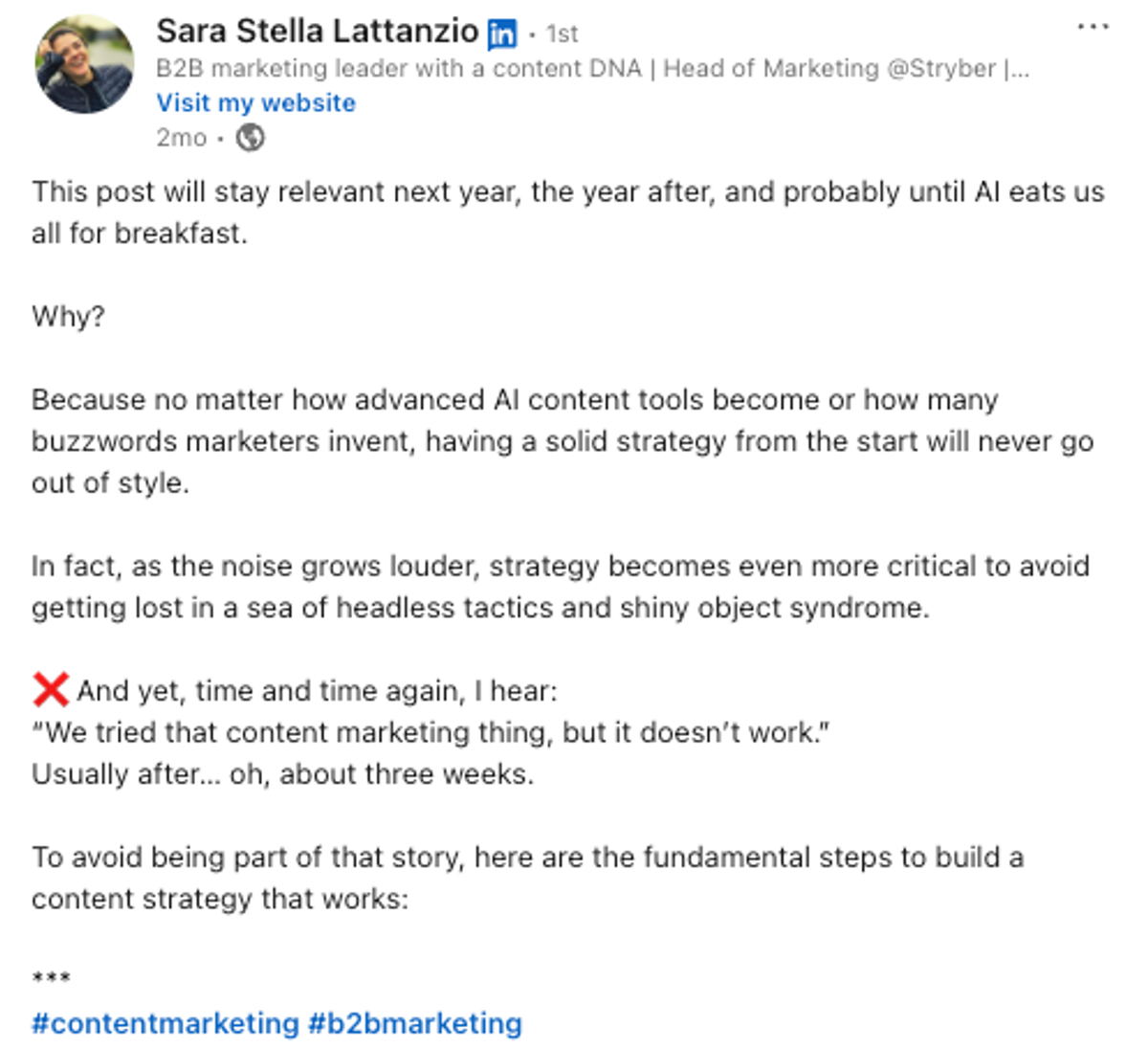
For example, Sara Lattanzio ran marketing at Stryber, a professional services firm with a market that isn’t very active online.
Instead of conducting online research to sense-check content ideas, she runs through a process of defining the business priorities and the goal of the content, and then confirming that the content idea fits her team’s areas of expertise. “Everyone wants to talk about AI to make noise, but do you actually sell AI? Are you really an AI expert? Well, if not, probably pick another topic, right? It doesn’t matter if it’s trending.”
Hold yourself accountable to your own strategy
In essence, it’s about remembering your content strategy. Tyler Hakes points out that your content strategy is there for precisely this reason, to stop you from falling in love with shiny new content objects. This is also where a lot of programs quietly come undone, one of the recurring patterns we unpack in why content strategies fail. Too many teams, he says, either confuse strategy with planning or tactics, or are unwilling to actually stick to their own strategy, “to sacrifice ideas that may be exciting but don’t align with the overall focus of the team or the business.”
“Slack’s engineers could get really excited about making video games instead of work software. But they don’t do that because it doesn’t align with their overall business strategy. The same general logic applies to content.”
When the founder’s favorite idea is the one to cut
For founder-led B2B companies, the falling-in-love trap has a specific shape. The idea that feels most exciting is often the one that flatters the founder’s expertise rather than the one a buyer would search for. The founder’s voice is usually your strongest asset, so muting it would be a mistake. What works instead is aiming that voice at the problems your buyers are actively trying to solve.
Start from what only your founder can say. The content ideas that win are the contrarian lesson from a deal that fell through, the number behind a bet that paid off, the process your team actually runs. Those carry a first-hand point of view a competitor cannot copy, and they map to questions real buyers are asking. Generic best-practice posts feel safe and rank for nothing. If you want to turn that voice into a repeatable program rather than the occasional viral post, our guide to founder-led marketing for content leads walks through the operating system behind it.
Then pressure-test each idea against the buyer, not the org chart. Ask whether a specific person in your ICP would stop scrolling for it, whether it speaks to a pain they spend real time and budget on, and whether you can tie it back to your product without straining. A founder-led idea that clears those three is worth building. One that only survives because the founder likes it is exactly the kind of darling this whole article is about learning to cut.
Create minimum viable content
Of course, sometimes a content idea really does fall into a grey area: it’s not clear if you’re a genius or just throwing spaghetti at the wall.
In that case, Ryan Law suggests, “Make the smallest possible version of it. See what happens. Spend more time and money if it does well. There’s a limit to the usefulness of theorizing about performance.”
Rachel Bicha gave examples of this approach in action:
“Will it boost our social media engagement long term if we do a contest to send someone on a free trip to Bali? Let’s do a contest first where we give someone $100 off their next flight. Oh, that worked really well! Ok, let’s find a sponsor to partner with us for the Bali idea.
“We would often run a small content series on Instagram or our newsletter before committing to a big content project that would live on our blog or website. It was a great way to test appetite and content-audience fit before expanding the scale.”
Test content ideas before going all in.
Relato helps teams validate concepts, gather audience signals, and ship minimum viable content without the operational overhead.
Use creativity for formats and tactics, but stay on message
Sara points out that “being creative” doesn’t mean you need to suddenly start talking about topics or building resources that aren’t in your wheelhouse. For content to make strategic sense, it needs to reflect your unique informational advantages and your product positioning, so even if you do jump on a trending topic, you should always “be able to tie it back to your own point of view and your own experience.”
The real opportunities for creativity, she explains, lie in the format and quality of your output, without straying off message in an attempt to be original.
Be prepared to take calculated risks
That said, Morgan Short points out that what often kills great content isn’t a lack of audience fit. It’s a lack of risk-taking: “More often than not, the problem I run into is actually yes, it has good audience fit, yes, it aligns with our strategy and feels really fresh and cool. But then it never sees the light of day.”
This usually comes down to a lack of buy-in, or a poorly defined list of stakeholders. If that is the wall your best ideas keep hitting, our playbook on getting internal buy-in for your content strategy covers how to line up sign-off before an idea stalls. Morgan’s advice is to “ensure that everyone who needs to sign off is identified right away at the beginning of the process, bought into the vision from the start. Obviously, there might be a little bit more upfront work to do that, but in the end, if everyone’s aligned with the strategy, then your idea is going to have a better chance of seeing the light of day.”
Once you’ve got that buy-in, it may well be worth taking a chance on a more imaginative content approach, says Trish.
“There is nothing wrong with having an innovative idea, and it ‘flopping.’ The only way you will know for “sure” if something will work is by following others who have done it first, and that’s not what innovating is about. Take the calculated risk, go with your full heart, and see what happens.”
There are ways to reduce the potential downside of taking a punt on a new content idea that might not land, Ryan Law says:
“Prioritize ideas that offer benefits even if they fail in their main goal — teach your team something, create a template for future work, make something useful for your sales team. The more potential upsides to a piece, the lower the risk of absolute failure.”
Be pragmatic
On the flipside, you have to be realistic about your team’s capacity and acknowledge the opportunity costs of the more experimental approach. Sara points out that fun experiments tend to suck up a lot of time, revision rounds, and budget. When forced to choose between a sexy new content idea, and something “more immediately tied to your audience,” she says her own choice is usually to “focus on the most important things.”
Rielle agrees: “A lot of it also boils down to logistics. Does it fit into an overall campaign that we’re already supporting? Do we have the resources to commit to creation and distribution? What’s the long-term plan for supporting this content (to make sure it isn’t just a random act of marketing that eventually gets forgotten)?”
Making creativity work means balancing ambition with reality. When you pair bold ideas with strategy and a clear sense of your team’s capacity, you’re more likely to create content that hits the mark without burning out your resources.
For best results, pair creativity with strategy
At Relato, we know how easy it is to fall in love with a bold idea, and how hard it can be to let go when it’s not landing. That’s why we’ve built tools to keep content teams grounded and audience-focused.
We believe that creativity shines brightest when paired with strategy. By simplifying workflows and making quick feedback accessible, we help you stay aligned with what your audience needs, without stifling your team’s creative spark.
Because at the end of the day, impactful content isn’t about the biggest or boldest idea. It’s about the right idea, delivered at the right time, to the right people.
Balance creativity with audience-first strategy.
Relato helps teams validate ideas, gather feedback, and ship content that actually resonates.
Frequently asked questions about choosing content ideas
How do you know if a content idea is worth pursuing?
Test it against your audience and your strategy before you commit real budget. A strong content idea maps to a problem your ICP is actively trying to solve, fits a topic you are genuinely positioned to own, and can be tied back to your product point of view. If an idea only excites your team but does none of those three, that is a flag, not a green light.
How do you validate a content idea before creating the content?
Ship the smallest possible version first. Run the angle as a LinkedIn post or a short newsletter section, watch whether it earns comments and saves, then scale the ones that land into a full piece. You can also poll your audience about the pain point behind the idea rather than the idea itself, since people will politely praise a concept they would never actually read.
What content ideas work for founder-led B2B companies?
The content ideas that win for founder-led B2B companies are the ones only the founder can credibly tell: the contrarian lesson from a deal that fell through, the number behind a bet that paid off, the process the team actually runs. Generic best-practice posts are easy to copy and rank for nothing. A founder point of view backed by first-hand experience is the informational advantage buyers cannot get anywhere else.
What is minimum viable content?
Minimum viable content is the smallest version of an idea you can ship to see whether it lands, before you commit a full production budget to it. In practice that is a LinkedIn post instead of a report, or a $100 giveaway instead of a free trip to Bali. You are buying a real audience signal cheaply, so the decision to scale up rests on evidence rather than on how much you like the idea.
How do you stop falling in love with your own content ideas?
Hold yourself accountable to a written content strategy so every idea has to clear the same bar, not just the ones you happen to like. Overindex on audience research so your instinct is trained on what readers want rather than what you find clever. And keep a habit of killing your darlings: the discipline to drop an exciting idea that does not fit is what separates a strategist from a hobbyist.