Why Content Strategies Fail
Six B2B content leaders share why their content strategies fell apart: missed audience research, the wrong goal, no ownership, and more. Plus how to avoid each one.



I didn’t think I’d be able to write this article.
I mean, come on. Getting B2B content leaders to open up about how they f*cked up? And not in a small, tactical way, but about the strategy behind the tactics?
Yeah…I was pretty sure nobody would talk to me about that. And then I’d fail spectacularly in my attempt to write an article about failure. How meta.
Luckily for me, content people are awesome. So I somehow managed to talk some real heavy hitters of the content world into ‘fessing up about the times when it all went wrong.
Read on to learn from:
Ryan Baum, 2 x Content Lead turned Content Consultant
Tommy Walker, Founder of the Content Studio, first marketing hire at Shopify Plus
Mary Scott Manning, Senior Content Manager at Domo
Halah Flynn, Senior Content Marketing Manager at Lattice
Katie Norris, former Content Lead at Adyen, now B2B Content Creator
Penny Warnock, Content Marketer at Contentoo
Ben Goodey, SEO Consultant & Founder of Spicy Margarita SEO
…and many more. They shared how they failed, why they failed, and, most importantly, what we can all learn from their hard-won experience.
Why do content strategies fail? The short answer
Across these conversations, six patterns came up again and again. Content strategies fail when teams:
- Build a plan without revisiting audience research, so the strategy answers the wrong question.
- Fall in love with an idea (a campaign, a format, a partnership) and stop listening to the audience.
- Assume a strategy that worked at one company will transfer to another, similar one.
- Chase the wrong goal: traffic instead of pipeline, vanity numbers instead of business outcomes, or a number leadership made up.
- Skip ownership, so every new stakeholder reopens the strategy mid-flight.
- Dabble in a new channel without a real plan, a real budget, or a channel-specific operator.
If you only have two minutes, the common content strategy mistakes table below summarizes all six side by side. The rest of this piece is six content leaders walking through which one bit them, and what they would do differently.
Not to ask an obvious question, but what is content strategy?
Before we can get into how content strategy fails, we’d probably better agree on our definition of a content strategy. As Fio Dossetto, the brand and marketing lead at Float, points out, strategy is one of those “black hole words” that “can mean everything, and therefore ultimately end up meaning nothing at all.”
“Strategy is one of those 'black hole words' that can mean everything, and therefore ultimately end up meaning nothing at all.”

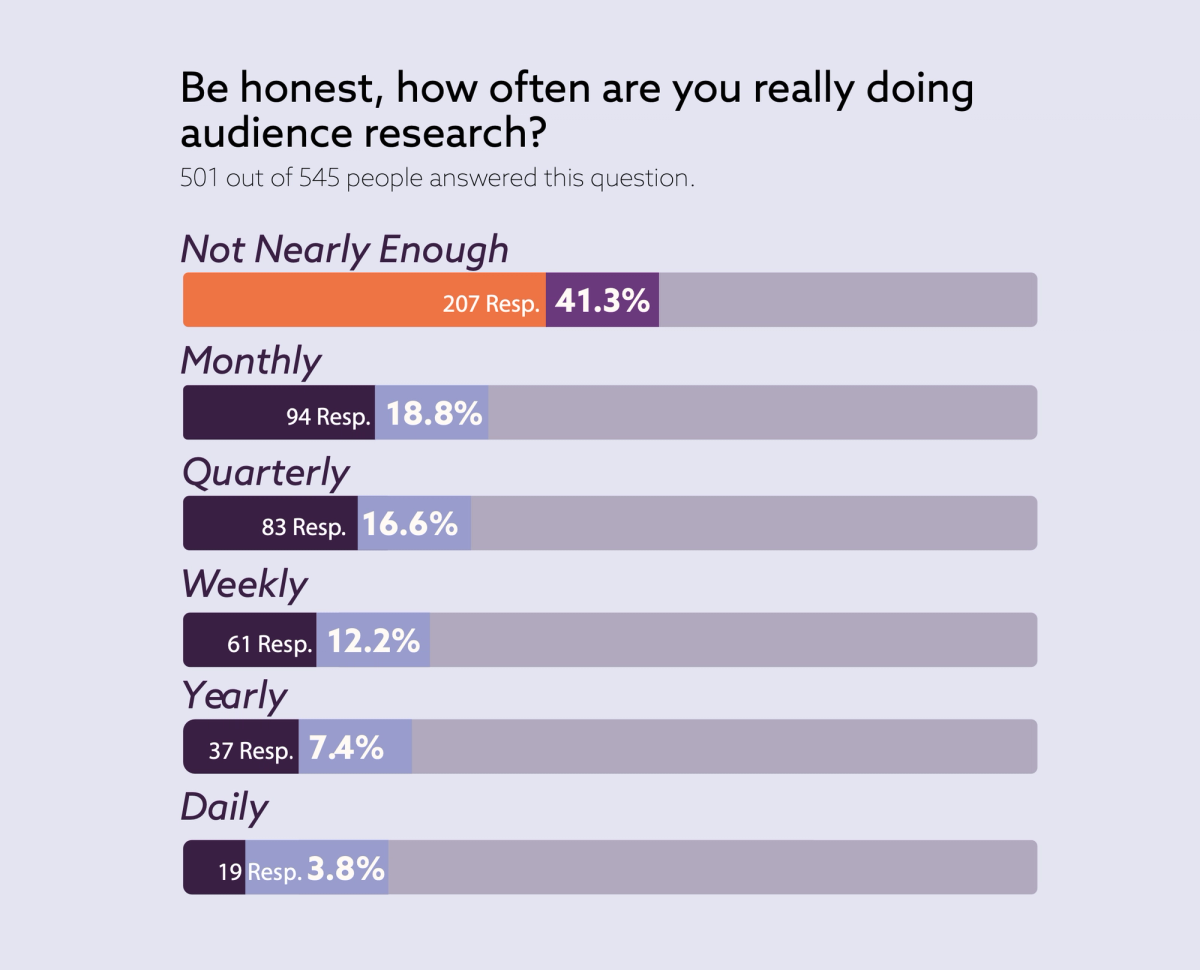
As a freelance writer, I know this intimately. Ask prospective clients about their content strategy, and many will talk about tactics, content calendars, or a wishlist of outcomes. Small wonder that Tommy Walker’s 2024 State of Discontent survey, which polled 545 content marketers, found over 40% struggling with a “lack of strategy”. We don’t even all agree about what a strategy is.
Here’s my best attempt at a working definition:
A content strategy is a guiding framework that defines why we are creating content, who it’s for, what content we create, how we distribute it, and what outcomes we are pursuing.
To paraphrase Dimitri Glazkov’s excellent article, “What Does It Mean to Be Strategic?”, our strategy is the connection between our intention (why we’re creating content in the first place) and our outcomes (what our content did.)
Coming up with a content strategy means:
Defining where we’re trying to get to (our intention)
Diagnosing how we can get there from here (our hypothesis)
Using that diagnosis to create a documented plan that outlines what we’re working on, why, and how you’ll measure your results (the strategy)
If you need a starting structure for that documented plan, the nine-step B2B content strategy framework walks through each piece and gives you a one-page template to fill in.
Implementing actions to drive towards that plan (the tactics)
Evaluating the outcomes of those actions to see if they did produce the results we wanted
A good content strategy, then, is simply a plan that delivers the outcomes that match our intentions.
What is content failure, and when is it a strategy problem?
Content failure is any case where published work does not produce the outcome it was commissioned to produce. That definition is deliberately wide, because the same phrase gets used for four quite different situations.
| Kind of failure | What you observe | Where the fix lives |
|---|---|---|
| Execution failure | The plan was sound. The piece shipped late, thin, or off-brief | Process and capacity |
| Tactical failure | One campaign, format, or channel missed its number while the rest of the program held | Test, learn, move on |
| Strategic failure | A run of tactics all miss, and the misses rhyme | Audience, goal, or positioning, upstream of any tactic |
| Measurement failure | The work performed and the dashboard could not see it | Attribution and goal definition |
The one worth catching early is the third. A single campaign that flops is information. A year of campaigns that flop in the same direction points at the audience or the goal, and tweaking tactics will never reach that far upstream. Strategic failure is also the hardest kind to spot from inside the team, which is why everything below comes from people who only saw it in hindsight.
Worth ruling out first: if performance used to be fine and slid quietly, you may be looking at content decay rather than a broken strategy, which is a maintenance problem with a much cheaper fix.
I don’t really love the term failure. Marketing, at its core, is about experimentation. You come up with a hypothesis about which actions will drive the results you want. You test the hypothesis, and you see how it goes. Then you learn.
As Mary Scott Manning puts it, failure is a “tool”, not a “verdict.” Strategies fall short all the time, but if you use the failure as a way to learn what to do differently, then it becomes useful learning.
Tommy Walker explains, “There are two levels of [failure]. One, things didn’t go the way that you wanted them to. But then the second part, the actual failure, is when you don’t do a post-mortem to reevaluate what it was that went wrong.”
In content, the only true failure is a failure to learn from your mistakes.
So, if strategic failure is inherently an opportunity for learning, then why is it so hard to talk about?
The stakes are high.
As Tommy Walker puts it, “A strategy is about how your brain pieces together the puzzle. And if it turns out that you spent all this time putting the puzzle together wrong, there’s a huge ego hit to that. And the more people that are involved, the more of an idiot you feel.”
Content people don’t feel very safe at the moment.
Failure is necessary. But admitting to failure requires psychological safety. And, as Walker’s “State of (Dis)content” survey clearly shows, content people were feeling pretty insecure when it was fielded:
More than 25% of content marketers report that their leadership is indifferent to, skeptical of, or dismissive about content.
56% report a lack of resources.
25% are worried about layoffs and budget cuts.
Those three figures come from the full 2024 report rather than its public summary page, which publishes only the headline that over half of respondents struggle to get support from leadership. I could not find a later edition of the survey, so read them as a 2024 snapshot rather than as this year’s number.
And, as Walker points out, “If your buy-in is so low in the first place, then, at the first hint of [a strategy] not working, then you’ve got a whole group of people being like, “Told you so.”
That makes it particularly impressive that some of these content experts were prepared to share their own hard-won lessons, so the rest of us can avoid the same pitfalls. Here’s what they told me.
Don't let your strategy die in a doc.
Relato connects strategy to execution so your plan stays alive from kickoff to publish.
The reasons content strategies fail, according to the experts, and how to avoid them
Quick preamble: frankly, most content strategies fail because of the context in which content happens. They fail because content teams are pulled in a million directions at once, and don’t have time to execute on the strategy.
They fail because content is measured on leads, but then judged on revenue. They fail because content lacks budget and buy-in. They fail because leadership is playing politics, or is just plain ignorant about how content works.
And that’s all true, but it isn’t very helpful.
Avoiding content strategy failure starts by taking ownership of what you can control, whether that’s building processes to avoid “too many cooks,” proactively securing leadership buy-in, or making a business case for audience research. If there’s one thing that all my sources told me, it’s that we have more power than we think. For the systems side of that ownership, see our practical guide on how to operationalize your content strategy.
OK, enough blurb, let’s get to the confessional. Why do content strategies fail, and what do the experts suggest that we do about it?
Forgetting the audience
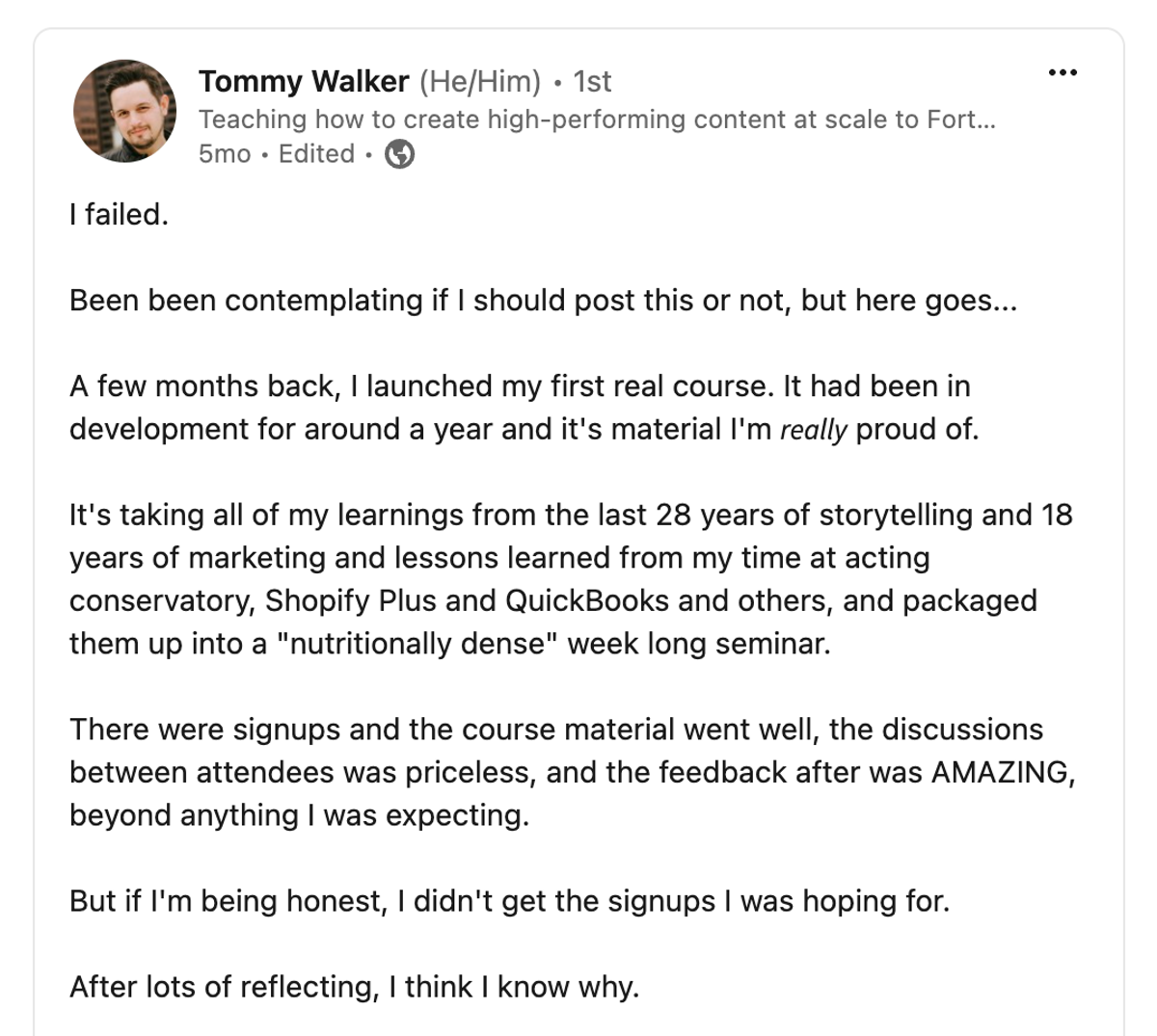
Even Tommy Walker fell into the trap of neglecting audience research when he launched his own course. His recent seminar didn’t initially get the signups he was hoping for. He puts this failure down to a lack of market research. While he’d done extensive audience research for his brand as a whole, he didn’t revisit that research before launching the new product.
Walker certainly isn’t alone in forgetting about the audience. Again, the recent State of Discontent survey saw over 40% of content professionals confessing that they weren’t doing nearly enough audience research.
Learning: Treat audience research as standard.
We know the best content comes from a deep understanding of our audience. And yet many of us aren’t carving out time to do it. Walker posits three theories as to why:
We’re too swamped.
We aren’t allowed.
We don’t know how.
All of that may be true, and solving those challenges is probably beyond the scope of this article. For a real-world look at how senior content marketers fit it in, our guide to audience research in the wild walks through their day-to-day tactics. But a simple place to start might simply be to build talking to customers into the day-to-day of content creation and ideation, suggests Fio Dossetto:
“In sports, you have to stretch, you have to warm up, or you’re going to hurt yourself. Why don’t you, as a marketer, have to spend time answering customer calls or interviewing customers as a thing that allows you not to hurt yourself later?”
Falling in love with an idea
As content creators, we know all about killing our darlings, as the saying goes. But as strategists, we need to have the same level of discipline. We dig into the trap in more depth in the dangers of falling in love with your own content ideas.
As a Senior Content Marketing Manager at Lattice, Halah Flynn works on one of the most successful content programs out there. But that doesn’t mean that every content strategy works, every time.
“We ran a sports-focused campaign to draw parallels between high-performing sports teams and HR’s pressure to drive high performance in the workplace. The idea was that partnering with sports teams would give us some high-level recognition at exciting events like professional sports games. But in practice, it was a lot harder to connect those dots for HR teams working outside the sports industry,” explains Flynn.
“The content itself turned out great (dynamic, bold, meaningful stories), and our partnerships with the teams remain strong, but it hasn’t been as effective as we’d hoped with the audience we were trying to reach.”
Learning: Prioritize content-audience fit.
For Flynn, the biggest takeaway was “the importance of listening to the audience instead of chasing something exciting.” Lattice’s strong suit as a content team comes down to a deep understanding of their audience.
Andy Przystanski, also a Senior Content Manager at Lattice, once told me that his team are “avid lurkers of Lattice’s online Slack community, Resources for Humans, and always have a pulse on what People teams are grappling with week to week. If you have an equivalent community you can tap into, take full advantage of that.”
While the sports-focused content concept they came up with was fun, moving away from that deep audience connection meant that it didn’t hit their desired outcomes.
That said, while this particular experiment didn’t turn out the way the team hoped, I suspect that having a content function with the budget and buy-in to experiment with bold new strategies is correlative with Lattice’s impressive organic traffic numbers.
Assuming what worked for one audience will work for another
Mary Scott Manning once took a content strategy that had been “ a runaway success story” when she’d applied it at a similar company, and brought it over to a new organization. The content they created “was beautiful—and it bombed. The returns we got just didn’t end up justifying the large investment made.”
Yeah, ouch.
“The returns we got just didn’t end up justifying the large investment made.”

Learning: Content is more context-dependent than you might think.
Manning’s mistake was to make the reasonable assumption that a strategy that worked for one audience would work for another, similar audience. But, she says, “Content doesn’t succeed based on its format alone, and a great content format can’t necessarily be copy/pasted from one client to another, even if they’re in similar industries.”
Her original strategy was successful because it was built on a solid foundation, “a combination of brand, community, and mission—not just format.” Choosing a format is a tactic, not a strategy, and without the basis of a solid strategy, even the most gorgeous content is likely to flop.
Don't let your strategy die in a doc.
Relato connects strategy to execution so your plan stays alive from kickoff to publish.
Chasing the wrong goal (or an impossible goal)
Choose an unrealistic, unhelpful, or unaligned goal, and you’ll run into avoidable failure over and over again.
Some different scenarios here:
The goal was unrealistic.
“The most common example” of content failure, says Ryan Baum, is a strategy that “drives results in the right direction, but not enough to pass the agreed-upon goal.” That might be because, while the strategy was good, you fell apart on implementation. Or, as Baum points out, your goal may have been “simply made up, as it often is in SaaS companies.”
“The most common example of content failure is a strategy that drives results in the right direction, but not enough to pass the agreed-upon goal.”

Of his own failures, Baum says, “I have been measured against (and denied promotions due to) made-up numbers, more than once. It is completely demoralizing from day one of the new quarter—if you’re a manager, don’t do this sh*t to your reports.”
The goal didn’t align with the business outcome you needed.
In an article on SEO mistakes, Ryan Law recalls absolutely smashing his traffic goals, and then realizing that this wasn’t necessarily good news:
“My biggest SEO fail was building our tiny (four-person) company blog to 1M monthly pageviews with tons of irrelevant skyscraper content, auto-generating PDF versions of every article, collecting thousands of emails and absolutely drowning our solo sales guy in terrible, terrible leads without a hope of ever converting. Learned the hard way that high traffic does not a business make.”
If you are sizing your content program for a startup specifically, our guide to content marketing for startups walks through the bootstrapped playbook in detail.
The strategy delivered a great result, just not the goal you wanted.
“Depending on how attribution is worked out internally, you could blow your goal out of the water—driving customers for another team’s channel,” says Ryan Baum.
“This is a net positive for the business, but it doesn’t show up on your dashboard or #wins channel shoutouts. Companies handle this in different ways, and it’s a major reason for misaligned incentives through attribution, which causes strategic issues and tends to be a culture killer.”
Learning: Set realistic goals that align with business outcomes.
Jimmy Daly, who founded Superpath and has since sold it, advises against setting unrealistic “stretch goals” that “kill morale and send a team scrambling to hit a goal that should never have been set in the first place.” In his article “Is your content strategy working?” Daly suggests breaking ambitious content goals down with shorter-term milestones and looking for positive trends, rather than a 100% hit rate.
“Every content strategy needs to leave some room for content that just doesn’t work,” he explains. “Shoot for 80% of new content to “work”—and shoot for content that can serve double-duty (i.e. rank for a keyword and be included in a lifecycle email).”
“Every content strategy needs to leave some room for content that just doesn’t work.”

And, crucially, set goals that align with the amount of time you have available. “You need to know how much time you have. You can’t build a strong organic presence in two months, but you likely could in 12 months.” In other words, your organic content strategy hasn’t “failed” if you haven’t built a strong presence in 6 months, assuming that you’re seeing an upward trend in key markers like MoM organic growth. Which markers belong on that list is its own argument, and our guide to measuring the ROI of content makes the case for the handful that survive scrutiny in a board meeting.
Failing to define ownership
I think anyone working in content is familiar with the experience of ‘death by too many cooks.’ You might have a great strategy, but you’ll never know. Because, when you’re trying to implement that strategy, you keep getting dragged back to the drawing board.
“There’s nothing worse than being on what you think is a final version and suddenly a comment appears in the doc from a totally new person saying: ‘Why are we writing this piece?’” says Katie Norris, former content lead at Adyen turned content consultant.
Learning: Establish stakeholders in advance, and defend your boundaries
At Adyen, after one too many stakeholder implosions, they established a “pretty tight process,” explains Norris:
“For any given content program, there was a marketing stakeholder who acted as an interface between the content team and the product team (plus any other stakeholder that might loom). It was their responsibility to ensure everyone was onboard and felt included at the right moments.”
A more formal alternative is the RACI matrix, a framework that specifies who is Responsible for the content (usually the creator), who is Accountable (aka the decider), who needs to be Consulted (other teams, such as product or legal) and who needs to be Informed. Setting this up in advance makes a clear statement about where the ownership of the content (and the responsibility for its success or failure) really lies. For a practical walkthrough, see our guide to defining content ownership.
Dabbling
Penny Warnock, a content marketer at Contentoo, recalls “testing out a new channel, but not creating a dedicated plan/strategy for it. This was due to time and capacity constraints, but meant we never got the traction that I know we could have if we had dedicated more time and attention.”
Warnock certainly isn’t the only content marketer who underestimated the lift of implementing strategy on a new channel. In particular, many content marketers overlook the need for someone with channel-specific knowledge involved in developing the strategy in the first place, says Tommy Walker:
“A lot of companies will do this. They’ll spend money to get a couple of YouTube videos out the door, and they think it’s just the quality of the YouTube video that’s going to carry it, without having an actual YouTube-specific strategist in place.”
Don't let your strategy die in a doc.
Relato connects strategy to execution so your plan stays alive from kickoff to publish.
Learning: Hire channel-specific specialists, and commit
No marketer is an expert in every channel and format. While some knowledge can be carried easily from one channel to another, many channels require their own specific strategy. And you don’t know what you don’t know.
The takeaway is pretty clear. As the great B2B content thought leader, Yoda, once said, when it comes to trying out a new marketing channel: “Do or do not. There is no try.”
Why good content still fails to generate leads
One version of the wrong-goal failure shows up often enough to deserve its own name: the content is genuinely good, everyone internally is proud of it, the talk went down well, and the pipeline does not move. Three things usually explain it, and they call for different repairs.
The content serves an audience that cannot buy. Ryan Law’s million-pageview blog is the extreme version, but the mild version is far more common. You rank for the practitioner’s question and you sell to the practitioner’s director. The reader is real. The buyer is somewhere else in the building.
The content had no life after its launch moment. A conference session, a launch week, a flagship report: the spike is real, and then nothing carries it. If the asset was never built to be found later, its entire return had to arrive in the first fortnight, and it usually does not.
Nobody instrumented the path from read to pipeline. This is the measurement failure above wearing a strategy costume. Before you conclude that the content failed, check whether anything downstream could have detected it succeeding. Our breakdown of the content ROI metrics that mislead teams covers which numbers keep teams looking in the wrong place.
You can usually tell which one you have with a narrow question: can anyone name a single deal where a person read this and then moved? If nobody can, you have a measurement gap and the content may be fine. If people can name the deals but none of them closed, you have an audience or an offer gap, and the content is doing its job for the wrong room.
Common content strategy mistakes at a glance
If you want the field-guide version, here are the six mistakes side by side, with the failure pattern, the fix, and the leader who learned it the hard way.
| Mistake | What it looks like | The fix | Source |
|---|---|---|---|
| Skipping fresh audience research | Strategy answers last year’s questions, or assumes generic ICP research still holds | Treat audience research as a recurring practice, not a project. Build customer calls into the editorial calendar | Tommy Walker, Fio Dossetto |
| Falling in love with an idea | The team rallies around a clever concept that excites internal stakeholders but not customers | Pressure test every concept against actual audience signals before committing budget | Halah Flynn |
| Copy-pasting a strategy across companies | A motion that worked at Company A is dropped into Company B with the same plan | Rebuild from intention, audience, and distribution; copy the principles, not the artifacts | Mary Scott Manning |
| Chasing the wrong goal | High traffic with no pipeline, or hitting a made-up stretch number nobody owns | Set goals that ladder to a business outcome, and break them into shorter milestones | Ryan Baum, Ryan Law, Jimmy Daly |
| No clear ownership | New comments appear on the final draft from people who were never briefed | Name one accountable owner per program, plus a RACI for everything else | Katie Norris |
| Dabbling in a new channel | ”Let’s try YouTube” with no channel strategist and no time horizon | Either commit a real strategist, budget, and 6 to 12 month horizon, or do not start | Penny Warnock, Tommy Walker |
For more on the systems side of avoiding these mistakes, our practical guide to operationalizing your content strategy walks through the workflow piece.
The only real content strategy failure is not failing
“Larger organizations are so risk averse that they’re often not putting themselves in a position to fail,” says Tommy Walker. The result? “Nope, we’re just going to do SEO content. I don’t care if it sounds like everybody else, we’re just going to do it.”
While a failed strategy is painful, not failing is worse. Not failing means not learning. It means hiding behind paint-by-numbers, boring, AI-can-do-it-for-us blog posts. It means reporting on pageviews and other meaningless traffic markers, rather than reporting on true engagement. It means never experimenting.
It’s false safety. Artificial success.
Instead, my sources all agreed, we should be aiming to fail often. Tommy Walker described the approach to content strategy that they took at Shopify: “You see a little bit of traction? Cool. You don’t see traction? Tweak, adjust. If it still doesn’t work, move on. Have your benchmarks for what you’re going to consider success at the level that you’re at. And then, if you hit those benchmarks, move your goalpost a little bit.”
And, because I can’t possibly write an article about failure without them, I leave you with the immortal words of Samuel Beckett:
“Ever tried. Ever failed. No matter. Try Again. Fail again. Fail better.”
Frequently asked questions about why content strategies fail
Why do content strategies fail?
Most content strategies fail for one of six reasons: the team skipped fresh audience research, fell in love with an internal idea, copied a strategy that worked elsewhere without rebuilding the foundation, chased the wrong goal (often traffic instead of pipeline), never named a single owner, or dabbled in a new channel without committing real time and a channel specialist. The fix is rarely a smarter plan. It is usually clearer intention, fewer goals, and a real owner.
What is content failure?
Content failure is any case where published work does not produce the outcome it was commissioned to produce. It covers four different situations that need different repairs: execution failure (the plan was sound, the work shipped late or thin), tactical failure (one campaign or channel missed while the rest of the program held), strategic failure (a run of tactics that all miss in the same direction), and measurement failure (the work performed and the dashboard could not see it). The expensive one is strategic failure, because tactical tweaking never fixes it.
What are the most common content strategy mistakes?
The most common content strategy mistakes are skipping audience research, falling in love with a clever idea before pressure testing it, assuming a playbook from one company will transfer to another, setting unrealistic or unaligned goals (made-up stretch numbers, vanity traffic), never defining who owns what, and trying a new channel without giving it a real strategy or operator. They show up in roughly that order in conversations with content leaders, and they compound: weak audience research makes goal setting harder, which makes ownership disputes worse.
What is the difference between a failed content strategy and a failed tactic?
A failed tactic is a single campaign, format, or channel that did not move the metric you wanted. A failed strategy is a misread of audience, market, or business context that produces a string of failed tactics. As Mary Scott Manning puts it, content does not succeed on format alone: if you keep changing tactics and getting the same disappointing result, the problem is upstream in the strategy, not the execution.
How do you know if your content strategy is failing?
The clearest tell is a gap between trend and target: traffic, leads, and engagement are flat or down quarter over quarter against a goal you committed to, and you cannot point to a specific lever that explains why. Other early signals: stakeholders reopen the strategy mid-program, the same audience question keeps surprising the team, sales does not recognize the leads the content produces, and the calendar fills with one-off requests instead of programs that ladder to the plan.
Why does good content still fail to generate leads?
Usually one of three reasons. The content serves an audience that cannot buy, so the reader is real but the buyer sits somewhere else. The content had no distribution beyond its launch moment, so its entire return had to arrive in week one. Or nobody instrumented the path from read to pipeline, in which case the content may not have failed at all and the reporting did. A quick test: can anyone name one deal where a person read the piece and moved? If nobody can, you have a measurement gap. If people can name deals but none closed, you have an audience or offer gap.
How long should a content strategy take to show results?
For organic search, a content strategy needs 6 to 12 months before it is fair to judge it, longer in competitive B2B categories. Jimmy Daly, who founded Superpath, frames it well: you cannot build a strong organic presence in two months, but you likely can in twelve, and the right thing to track in the meantime is the trend (month over month organic growth, share of organic visibility on target topics) rather than the absolute number. Demand and lifecycle content can show results faster, in the order of 60 to 90 days.
How do you fix a content strategy that is already failing?
Run a quick diagnostic in this order: is the audience definition still accurate, is the goal aligned to a business outcome (not a made-up number), and is there one named owner per program. Almost every fix starts in one of those three places. From there, kill the bottom 20 percent of work that is not laddering to the plan, double down on the top 20 percent that is, and put a 30, 60, and 90 day milestone on the diagnostic so you can tell whether the new direction is working.