An Editor’s Guide to Constructive Feedback: How to Build a Feedback Flow That Works for Everyone
Learn how to give clear, constructive feedback that builds trust, inspires writers, and helps your team deliver better content every time.



You know how to dot the i’s and cross the t’s. You’ve got the writing guidelines: grammar rules, words to avoid, and even how your em dashes should look. So why are you still getting subpar writing from your team, even after you’ve redlined endlessly?
Here’s the thing: Feedback isn’t just about what you say, it’s about how you say it. The way you give feedback can inspire action, lift up your writers, and unlock their best work. Or it can frustrate, confuse, and stall the process. So what’s the move?
I tapped into some of the smartest editors and writers I know to figure out what’s missing, and what actually works. This article will show you how to turn feedback into a strategic tool. Clear, constructive, and collaborative feedback shouldn’t only fix a draft. It should build trust, keep your team aligned, and level up your content across the board.
Let’s dig in.
Why feedback often falls apart
Giving feedback seems simple: spot the problem, point it out, and move on. But too often, feedback creates frustration instead of clarity. Here’s why, and how to fix it.
Vague comments
“Make it better” doesn’t help anyone. Writers need specifics to understand what “better” actually means, especially writers with neurodiverse needs who benefit from clear, concrete direction. Feedback like “I love this section!” feels nice but doesn’t teach the writer what to replicate next time.
As Kelly Fiorini puts it, “Instead of saying, ‘I love this section!’ say, ‘These bullets make this section so skimmable for the reader—great choice!’” Specific praise and actionable edits make all the difference.
Example: Instead of “This doesn’t work,” say, “Can you make this section focus more on the customer’s challenges?”
Scattered communication
Nothing derails a draft like scattered feedback. Notes buried in email threads, Slack messages, and comment bubbles leave writers scrambling to find the right version of the feedback.
Imagine you’re a writer revising a draft based on a Slack message from last week, only to find out the team changed direction in a new email. It’s a recipe for frustration and wasted effort.
Keep all edits in one centralized tool to avoid the back-and-forth chaos. For many teams, Google Docs works well because it allows real-time collaboration and keeps comments attached to the latest version of the document. Whatever platform you use, make it the go-to place for all feedback, so writers always know where to look.
Inconsistent guidelines
Feedback that conflicts with your brand voice or style guidelines leaves writers guessing. When expectations aren’t clearly defined, it’s easy for confusion to creep in and revisions to pile up.
Kelly emphasizes the importance of setting expectations: “Be super clear about your expectations upfront. If you expect the writer to follow the outline to a Tee, let them know. If you trust them to make changes, communicate that as well.”
Example: A freelancer receives conflicting feedback about whether humor belongs in the copy. One person loves a joke, someone else wants a more formal tone. Without clear guidance, the writer is left to guess, and that rarely ends well.
Too many cooks
Ever been caught in a feedback loop where everyone has a different opinion? It’s not pretty. Conflicting notes (like tone preferences from a marketing lead and a CMO) slow the process and frustrate writers.
To avoid feedback confusion, designate a single point of contact or final decision-maker. Fewer cooks, better stew.
Missed opportunities
Poor feedback isn’t just frustrating, it’s a missed opportunity to build up your team. Every round of feedback is a chance to onboard freelancers, inspire better writing, and clarify your brand’s voice.
Clear, constructive feedback teaches writers what works so they can deliver stronger drafts moving forward.
Unclear focus
Writers thrive with clear direction. Without it, you’ll end up with wasted time, rewrites, and stress on both sides.
Gillian Hill highlights a common issue called “drift,” where drafts lose focus, and the most important idea ends up buried.
“Sometimes I notice in drafts that the headline or subject line doesn’t entirely match what they’ve written about, and that’s often to do with drift. The most important point can end up in the last paragraph when it should have been the focus all along.”
To prevent drift, align your team on the purpose of the content before drafts get underway, and revisit that purpose when giving feedback.
Feedback is a conversation, not a critique
Feedback isn’t about catching mistakes but helping writers do their best work.
For in-house teams, feedback should guide and inspire.
For freelancers, it’s also an onboarding tool, showing them how to write for your brand while keeping the process collaborative. Think of yourself as a mentor, not a critic. With strategy-led freelancers the exchange runs both ways, since part of what you are paying for is their read on whether the brief was right.
Make it a two-way conversation
Feedback works best when it flows both ways. Invite writers to share what they found unclear or challenging about your notes. This will help you improve your feedback and make the writers feel heard.
Ask, “Did anything in my notes leave you scratching your head?” Questions like this open the door for better communication and show writers you value their perspective.
Ground your feedback in the style guide
Subjective comments are frustrating because they don’t explain what’s wrong or how to fix it. Instead, connect feedback back to your style guide.
As Gillian says, “Providing feedback that connects back to your style guide helps avoid comments like, ‘This feels fluffy,’ and makes it clear why something doesn’t align with your brand.” For example, “This sentence feels too long for our audience. Our style guide recommends 12-15 words per sentence for readability.”
When feedback ties directly to guidelines, it removes subjectivity and gives writers actionable steps to improve.
Use inclusive language
The tone of your feedback can make a big difference in how it’s received. Comments phrased as commands might feel harsh, even if they’re accurate. Shifting to collaborative language helps create a sense of partnership and mutual respect.
Kelly Fiorini puts it this way: “Sometimes using ‘we’ rather than ‘you’ can help soften your tone and show that you think of the writer as a partner. For example, ‘We still need to find a way to include X. Maybe in this first section?’”
It’s a small change that goes a long way in building rapport.
Be specific with praise
Writers need to know what’s working, not just what needs fixing. Specific, actionable praise gives writers a clear idea of what to replicate in the future. Instead of saying, “I love this!”, explain why it’s effective.
Example: “I love the emotional hook of this headline, it’s perfect for grabbing the attention of our audience” Comments like this reinforce good decisions and help writers understand what to do more of.
Focus on alignment and growth
At the end of the day, feedback should do two things: align the content with your goals and help writers grow. For in-house teams, that means offering guidance to develop their skills over time. For freelancers, it means clear, brand-aligned input that sets them up for success.
Framing feedback as a coaching opportunity rather than a critique creates trust, collaboration, and better content.
What makes feedback actually helpful
Writers want feedback they can use, not vague notes that leave them guessing. Helpful feedback is clear, actionable, and specific. Here’s how to make it count.
Be specific: Vague feedback like “This doesn’t work” doesn’t tell the writer what’s wrong or how to fix it. Replace those comments with clear suggestions. Concrete examples go a long way in guiding writers toward what you need.
Example: Instead of saying, “Make this stronger,” try, “Focus more on the emotional impact of the customer’s problem.” This tells the writer exactly what to improve and how.
Keep it actionable: Tie every piece of feedback to a clear next step. When feedback is actionable, writers can dive in without second-guessing what you mean.
Example: “Add one sentence here summarizing why this solution matters.”
Provide examples of your brand’s writing: Sometimes, showing is better than telling. Share examples of content your team is proud of so writers have a reference for style, tone, and structure.
“Point new-to-you writers in the direction of published content that your team is proud of,” says Kelly. “Examples help—a lot.”
Be kind but honest: Writers need to know what’s working just as much as what needs improvement. Highlight wins alongside your edits to keep feedback balanced. Specific praise also helps writers understand what to do more of in the future.
Example: “This intro is great, let’s build on this energy in the body copy.”
Watch your tone: The way you phrase feedback matters. Harsh comments can feel demotivating, even when they’re accurate. Choosing collaborative language can make a big difference in how feedback is received.
Example: Instead of saying, “You missed the point here,” try, “Let’s refocus this section to highlight the customer’s challenge more clearly.” This approach keeps the conversation constructive and emphasizes teamwork.
Small shifts in tone like this help feedback feel more collaborative and build stronger partnerships with your writers.
Stay consistent: Feedback should always align with your brand voice and style. Inconsistent feedback can confuse writers and lead to extra rounds of revisions. A style guide or checklist can help keep feedback focused.
Simplify lengthy style guides into a short checklist of the most essential 8–12 items. “Long, detailed style guides cover all your bases, but they can be overwhelming,” Kelly advises. “Condense them into an actionable checklist of the most essential 8–12 items to remember.”
Use a scoring rubric: A scoring rubric simplifies feedback, turning subjective opinions into actionable guidance. It outlines clear criteria (like tone, clarity, brand alignment, and structure) and assigns scores to each, creating a roadmap for improving drafts.
Gillian explains, “A scoring rubric is a great self-checklist for writers and helps teams understand what is ‘good enough’ for different types of content.”
Here’s an example:
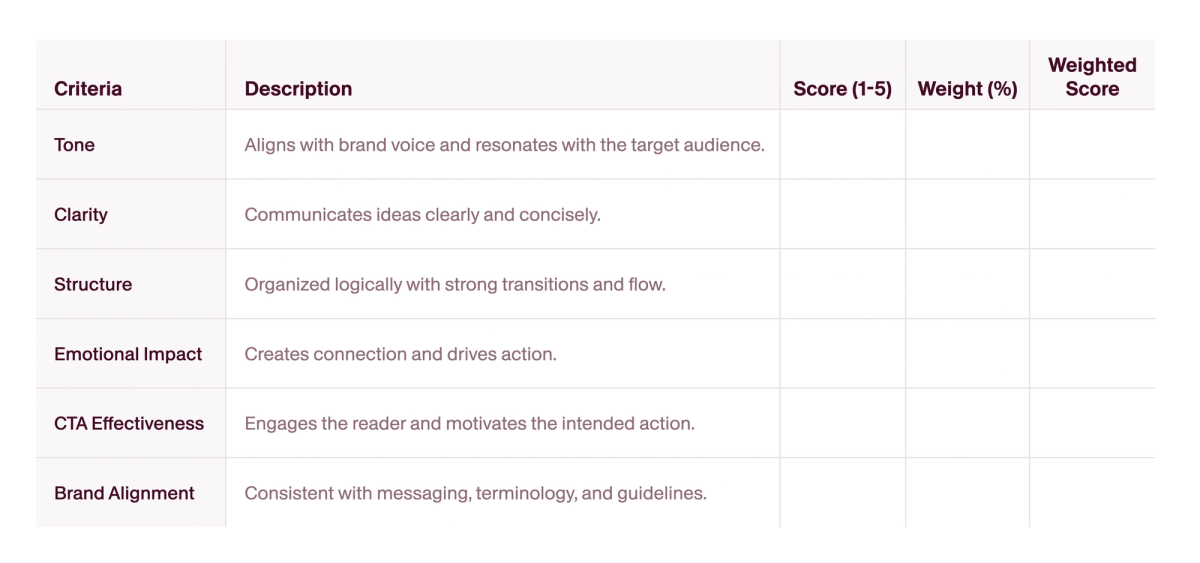
Total Score: Add weighted scores for all criteria.
Publishing Threshold: Decide on a minimum score for publishing (e.g., 80%).
In practice, a rubric helps:
Set clear benchmarks: Define acceptable scores for different content types. For example, a cornerstone blog might need perfect brand alignment, while a newsletter allows more flexibility.
Focus on key priorities: Highlight non-negotiables like CTA effectiveness or emotional resonance based on the content’s purpose.
Streamline decisions: Use the total score to decide if a draft is ready to publish or needs revisions.
Constructive feedback examples in a formal tone
Not every team works in a casual Slack voice. Agencies, regulated industries, and cross-functional reviews often call for a more formal register, where the note has to stay professional even when the message is critical. Constructive feedback in a formal tone names the specific problem, ties it to an agreed standard, and proposes a concrete revision, all without slang, exclamation points, or personal phrasing. The tone is measured. The substance is still specific.
Formality is about register, not vagueness. A formal note is not a softer note. It still points to a spot and asks for a change. Here are before-and-after examples you can adapt:
| Casual note | Formal-tone rewrite |
|---|---|
| ”This intro is kind of slow." | "The introduction reaches the core argument in the fourth paragraph. Please move the primary claim into the opening two sentences so the reader encounters it first." |
| "Love this, but it’s a bit much." | "This section is effective. It currently runs to six examples where two would carry the point. Please retain the two strongest and remove the rest." |
| "This feels off-brand." | "This passage does not align with the style guide’s guidance on sentence length, our 12 to 15 word target. Please revise the flagged sentences to meet that standard." |
| "Can you fix the ending?" | "The conclusion restates the introduction without advancing a next step. Please close with a single, specific call to action tied to the reader’s goal.” |
Two rules keep a formal note constructive rather than merely polite. First, anchor every request to a shared reference: the brief, the style guide, or the audience definition. “Please revise to meet the style guide’s 12 to 15 word target” reads as a craft decision, while “please shorten this” reads as an opinion. Second, state the requested action, not just the problem. A formal note that identifies a flaw but leaves the fix unstated forces the writer to guess, which is the opposite of constructive.
If your reviews routinely pull in legal, product, and brand stakeholders who each write in their own register, one owner should reconcile those notes before the writer sees them, the same discipline that keeps editorial standards consistent as a content program scales.
How to handle conflicting feedback on content drafts
Conflicting feedback is the single most common reason a good draft turns into a stuck draft. The CMO wants a punchier intro. The brand lead wants warmer copy. The product marketer wants the feature mentioned three more times. The writer, staring at three contradictory comments on the same paragraph, freezes.
The fix is structural, not political: one owner reconciles every conflict before the writer sees it.
Route all notes through one editor
Let stakeholders comment freely, but require the lead editor or content owner to be the only person the writer responds to. The editor reads every note, resolves the contradictions, and hands the writer one clean set of edits. The writer never has to decide whose opinion wins.
If a CMO note says “make this punchier” and a brand lead note says “soften this,” the editor picks one, replies in the comment thread with a one-sentence rationale (“going with punchier, the brief is a top-of-funnel piece”), and resolves the other.
Anchor every note to the brief
When two stakeholders disagree, the brief is the tiebreaker. If the brief says the audience is a VP of Marketing and the draft is being pulled toward an IC reader, the VP-focused note wins. If the brief is silent, that is a sign to fix the brief, not to argue in the doc.
This is the hub and spoke approach Gillian Hill describes: stakeholders agree at the brief level (the hub), and individual comments (the spokes) have to trace back to it.
Use a quick conflict-resolution rubric
When you do hit a real disagreement that the brief cannot resolve, put it through a three-question rubric before deciding:
- Which note serves the reader? Reader > stakeholder, every time.
- Which note is anchored in the style guide? Style guide > taste.
- Which note has data behind it? Past performance > opinion.
If two notes tie on all three, the content owner makes the call and documents the reasoning in the doc. Writers can handle a tough decision. They cannot handle ten unresolved decisions stacked on the same paragraph.
Kill the dueling drafts pattern
A common anti-pattern: the writer sends a draft, stakeholder A sends edits in Slack, stakeholder B replies with conflicting edits in email, the writer makes both sets of changes in parallel, and now there are two versions of the same paragraph living in different threads. By the time anyone catches it, no one knows which version is canonical.
Force every note back into one centralized doc before the writer touches it. If a stakeholder sends a Slack message, the editor copies it into the draft as a comment and replies in Slack with: “captured in the doc, see comment 14.” The doc is the source of truth. Slack is the conversation, not the record.
How to give feedback to a freelancer: best practices
In-house writers and freelancers need different feedback. In-house writers can absorb a hundred small notes over six months and grow with you. Freelancers usually get one or two projects to figure out your brand voice, unless you have deliberately moved one into a content partner role, in which case feedback becomes an investment rather than a correction. The feedback you give them either onboards them well or burns them out, and vague feedback ranks fourth on the list of pain points freelance content marketers report. Ask a bench what they actually want to hear and the answer is consistent: dozens of them told us that being told what worked, not only what to fix is what keeps them coming back.
Lead with one piece of specific praise. Not “great draft.” Something like, “the second case study transition is doing exactly what we want, that is the rhythm to hit.” This is praise that teaches.
Group edits into three buckets. Must-fix (blocks publish). Should-fix (improves quality). Optional (taste). Keep must-fix short, around three to five items. A freelancer who sees a list of forty equal-weight notes will rewrite the whole piece in a panic. A freelancer who sees five must-fixes will fix five things, well.
Tie every note to the brief, the style guide, or the audience. Never to your personal preference. “This sentence runs long for our 12 to 15 word target” beats “I’d shorten this.” The first is a craft decision. The second is your mood.
Set the revision scope explicitly. Tell the freelancer how many rounds you expect, what counts as in-scope, and what would trigger a rescope conversation. Most disputes with freelancers are scope disputes that started as feedback disputes.
Onboard through the first three pieces. A freelancer’s first piece will need the most feedback. The second piece will reveal which patterns stuck. By the third, you should be giving meaningfully less feedback. If you are not, the brief or the style guide is the problem, not the freelancer. Treat the first three pieces as freelance onboarding, not production.
Ask for revisions politely without going soft. Politeness is not vagueness. “The intro still leads with the product instead of the reader’s pain. Can you rewrite the first two paragraphs to open on the freelancer’s biggest pain, then bring in the product as the answer?” That is polite. It is also a concrete ask.
The freelancers you want to keep are the ones who take direct, specific feedback well. Trust them with it.
Building a feedback flow that works
A messy feedback process slows everyone down. Centralizing, streamlining, and tailoring your approach saves time, reduces frustration, and sets your team up for success.
Centralize notes
Scattered feedback across emails, Slack messages, and comment threads leads to unnecessary confusion. Writers need one clear place to find all notes and updates. Whether it’s a shared document, project management tool, or a dedicated email chain, having a single platform keeps everyone aligned and reduces wasted time.
As Kelly says, “Having a clear, consistent communication process is crucial. If your writers have essential questions, make it clear where they should ask—whether it’s a project management tool, messaging platform, or email.”
A tool like Relato can help by keeping all feedback, drafts, and updates in one workspace. With everything in one place, your team can collaborate seamlessly without hunting down notes or juggling platforms. Centralization keeps the process simple and efficient.
Assign clear ownership
For in-house teams, decide upfront who owns feedback and who has the final say. Too many decision-makers can create bottlenecks and confusion. A single point of contact keeps feedback organized and actionable. If stakeholder input is the deeper problem, the content ownership playbook covers how to assign RACI roles so feedback lands in the right window instead of mid-revision.
Follow up with freelancers
Don’t leave freelancers guessing after edits. If feedback feels unclear or they’re unsure about next steps, follow up with clarifications. A quick check-in can help avoid extra rounds of revisions.
Set clear timelines
Writers do their best work when they know what’s coming. Set clear deadlines for feedback, revisions, and final approvals. Timelines keep everyone accountable and make the process predictable.
Create style guides and templates
Equip your writers with the tools they need to succeed. Style guides and templates set expectations upfront and make it easier to hit the mark with fewer edits. If your style guide feels overwhelming, condense it into a short checklist of essentials.
Tailor your approach
Feedback looks different for in-house teams and freelancers.
For in-house teams: Growth-oriented feedback helps team members develop their skills over time.
Example: “You’re getting better at transitions, let’s work on making this one smoother.”
For freelancers: Precise, brand-aligned guidance gives freelancers the direction they need to deliver what you’re looking for.
Example: “This section’s tone feels a little too formal for our audience.”
Use the hub and spoke model
To keep feedback aligned, Gillian recommends starting at the 10,000-foot view with a solid brief. The brief (or “hub”) lays out your goals, audience, and key points. From there, writers create outlines and drafts (the “spokes”).
This is also how you prevent the scattered Frankenstack of feedback that buries the writer in conflicting notes across five tools.
She explains, “If changes need to be made, make the agreement at the 10,000-foot view—not in the details of the copy.” Updating the hub keeps everyone on the same page, even as stakeholders weigh in.
If major shifts come up mid-draft, revisit the hub. Aligning at the brief level prevents confusion, stops drafts from drifting, and keeps feedback focused on the original purpose.
The bigger picture: why thoughtful feedback matters
Thoughtful feedback does more than fix typos or tighten grammar. The real value of feedback lies in its ability to deepen ideas, connect with readers, and create content that drives action. As Erica Schneider says, “Good editing is good rethinking.”
Effective feedback empowers writers to think strategically about how they package ideas, build emotional resonance, and remove friction for the reader. Thoughtful feedback:
Builds trust: It shows writers you’re invested in their success. When writers feel supported, they stick around longer and keep improving. As Kelly puts it, “Thoughtful feedback helps you build trust and rapport with your writers so they stick around.”
Develops stronger writers: Constructive, clear feedback builds confidence. Instead of focusing only on surface-level edits, highlight how writers can sharpen their ideas and strengthen their narrative. Over time, writers will learn to deliver work that’s more aligned with your goals.
Elevates content: Good feedback turns a draft into something that resonates. It’s about more than grammar. Instead, it’s about creating aha! moments, removing friction, and guiding readers to take action. When feedback focuses on clarity, strategy, and emotional impact, every piece becomes stronger.
Fosters collaboration: A good feedback flow keeps everyone aligned and moving toward shared goals. When writers and editors work together to rethink and refine ideas, the process feels smoother, the results are better, and the relationships are stronger.
Every edit, suggestion, and conversation is a chance to create something exceptional, not just in the content but in the people who create it. Strong feedback builds trust, sharpens skills, and elevates everything your team touches.
Frequently asked questions about editor feedback
What is constructive feedback in a formal tone?
Constructive feedback in a formal tone names a specific problem, ties it to an agreed standard such as the brief or style guide, and proposes a concrete revision, all in a measured, professional register without slang or exclamation points. Formality changes the wording, not the substance. The note is still specific and still asks for a defined change, for example: “The introduction reaches its main claim in the fourth paragraph. Please move that claim into the opening two sentences.”
What are examples of constructive feedback in a formal tone?
Replace “this intro is slow” with “the introduction reaches the core argument in the fourth paragraph; please move the primary claim into the opening two sentences.” Replace “this feels off-brand” with “this passage does not align with the style guide’s 12 to 15 word sentence target; please revise the flagged sentences.” Each formal example points to a specific spot, cites the standard it misses, and states the exact change requested.
How do you handle conflicting feedback on content drafts?
Route every note through a single decision-maker who owns the brief. Let stakeholders comment freely, but require the lead editor (or content owner) to reconcile contradictions before the writer sees them. If two notes conflict, the editor picks one, explains why in a sentence, and resolves the other comment. The writer should never have to choose between a CMO’s note and a brand lead’s note on their own.
What is a constructive feedback example for a content draft?
Replace “this section doesn’t work” with “this section spends three paragraphs on background before the customer pain point shows up. Move the pain point to the second paragraph and cut the history down to one sentence.” Constructive feedback names the problem, points to a specific spot, and proposes a concrete fix the writer can act on in one revision pass.
How do you give feedback to a freelancer without discouraging them?
Lead with one piece of specific praise tied to the brief (not a smiley face), then group your edits into three buckets: must-fix (blocks publish), should-fix (improves quality), and optional. Keep the must-fix list short, around three to five items. Always tie a note to either the brief, the style guide, or the audience, so it reads as a craft decision instead of a personal preference.
How do you ask a freelancer for revisions politely?
Acknowledge what is already working, name the gap between the draft and the brief, and propose a fix in the same sentence. For example: “The structure is solid. The intro still leads with the product instead of the reader’s problem. Can you rewrite the first two paragraphs to open on the freelancer’s biggest pain, then bring in the product as the answer?” Polite, in editing, means specific plus respectful, never vague.
How many rounds of feedback should a content piece get?
Two rounds is the working default for most content teams: one structural round on the outline or first draft, one line-edit round on the revision. A third round signals a problem upstream, usually a fuzzy brief, misaligned stakeholders, or a draft that should have been killed at the outline. If you are routinely on round four, fix the brief, not the draft.
What should an editor’s feedback flow look like?
One central place for notes (a doc, a project tool, or a workspace like Relato), one owner who reconciles conflicting input, a short style checklist of eight to twelve must-hit items, a clear timeline for each round, and a rubric for what “done” means. Everything else, Slack threads, email chains, ad-hoc DMs, should funnel back to the one source of truth before the writer touches the draft.
Feedback that builds better content, and better teams
Thoughtful, clear, and actionable feedback does more than improve a single draft. It strengthens relationships, inspires writers, and helps teams work smarter together. When feedback feels like a conversation instead of a critique, everyone (from in-house teams to freelancers) produces better work and moves in the same direction.
Start with alignment, stay consistent, and focus on helping writers grow. Treat feedback as a chance to guide, collaborate, and connect. It’s not about endless rounds of revisions: it’s about building trust and creating content that hits the mark.
The next time you’re giving feedback, remember this: small changes in how you communicate can lead to big wins for your team, your process, and your content.