The Rise of Strategy-Led Freelancers: How They’re Changing Content Creation
Freelance strategists are redefining content marketing. Learn how to onboard them into your strategy with actionable insights and real-world examples.



Freelancers used to be the people you handed a brief to and hoped they’d deliver. They were reliable extra hands when in-house teams needed support.
But freelancing has evolved. The role of freelancers today is far more strategic. The shift is part defensive (many of the pain points content marketing freelancers face are pushing pure execution work out of the market) and part offensive: clients are willing to pay for thinking, not just typing.
Now, freelancers shape content strategies. They bring niche expertise and sharp insights that help brands rethink their approach to content marketing. This shift is transforming the way teams create content. Brands are seeing higher engagement, improved workflows, and content that speaks directly to their audience.
For marketers juggling tight deadlines and limited resources, involving freelancers in strategic roles can feel overwhelming. But with the right setup, it simplifies workflows and delivers stronger results. Freelancers can take on more than execution: they can bring structure to your processes and add creative problem-solving to the mix.
This article explores why strategy-led freelancers are gaining traction, the specific ways they’re changing content creation and practical tips for building partnerships that work. Once you have found a strategy-led freelancer worth keeping, the next question is how to turn them into a long-term content partner rather than a writer you re-brief from scratch every month.
If you’re a content manager, agency lead, or marketer with too much on your plate and too few resources, this is your guide to collaborating smarter and getting better outcomes from freelance talent. The client habits that make experienced freelancers want to keep working with you are a separate problem, covered in what your freelance bench wishes they could tell you.
Why freelancers are moving beyond execution
Today’s content teams are juggling endless deadlines, tighter budgets, and the constant demand to deliver campaigns that actually move the needle. It’s no wonder they’re turning to freelancers who can go beyond ticking off tasks and help shape the big picture.
The demand backs this up. When Semrush surveyed more than 700 marketers in 2021 about where they get content from, independent freelancers with solid experience and an established personal brand took 47% of the vote, ahead of agencies at 27% and content marketplaces at 24%. Two caveats before you lean on that number: the question was put only to companies that outsource at all, and the survey is now close to five years old. Read it as evidence that experienced freelancers lead the field, not as a current market share.
Freelancers have become increasingly aware of workflow gaps within content teams and have adjusted their services to meet this shift.
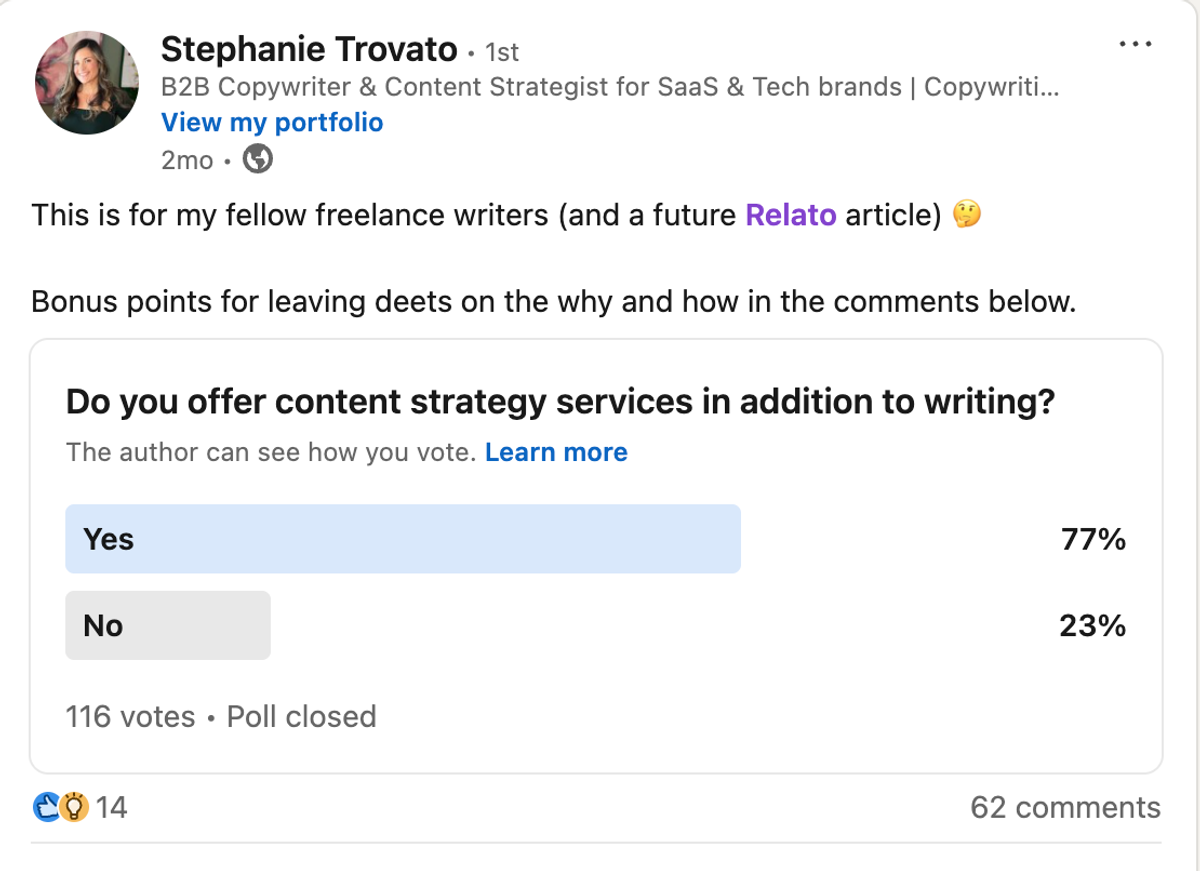
Source: LinkedIn
Meeting the demand for strategic content
Content teams are expected to deliver campaigns that move the needle on business goals. That’s where freelancers like Rebecca Rosenberg shine. She breaks down complex content strategies into actionable plans that drive measurable results.
Linsey Knerl brings a different kind of expertise. With years of experience in EdTech, she designs strategies tailored to niche audiences. Her content directly addresses market pain points and helps clients build trust with their customers. Her approach has helped brands launch products successfully, expand their audience reach, and achieve higher ROI on content campaigns.
Freelancers redefining expertise
Freelancers today are more than hired hands. They’re developing deep expertise in specific industries like B2B SaaS and EdTech. They combine strategic thinking with skilled execution, creating opportunities for marketers to elevate their campaigns.
Take Lindsey Tague, for example. She works with startups to identify gaps in their marketing plans and fills them with precision. Her dual role as a strategist and executor helps startups build strong foundations and execute campaigns that generate leads and drive growth.
Jennifer Phillips April brings a unique focus to her work. She connects SEO strategies with buyer intent, crafting content that speaks directly to audience needs. Her approach drives better search rankings, improves website traffic, and helps brands convert visitors into customers.
For marketers, tapping into this level of expertise unlocks significant advantages. Freelancers like Lindsey and Jennifer bring fresh insights, specialized knowledge, and tailored solutions that help teams meet deadlines and exceed their goals. Their contributions allow in-house marketers to focus on big-picture strategies while freelancers handle execution with confidence.
Bringing fresh eyes to the table
One of the biggest strengths freelancers bring to the mix is their ability to spot opportunities that in-house teams miss, such as untapped audience segments or overlooked distribution channels. This fresh input can refine strategies and improve campaign outcomes.
Crysta Vesely takes this approach to another level. She starts by asking foundational questions about the audience, content goals, and how a piece fits into the larger strategy. These conversations often lead to clearer plans and sharper messaging.
Bring strategic freelancers into your workflow.
Relato makes it easy to onboard freelancers as true collaborators, not just extra hands.
For well-organized teams, her insights validate their efforts while uncovering areas for improvement. For smaller teams, she collaborates closely to develop strategies from scratch.
Her process creates clarity and reduces frustration. Campaigns guided by her input often achieve higher engagement, stronger audience connection, and better alignment with business goals. Whether it’s refining a brief or reshaping a strategy, her contributions help teams produce work that delivers real results.
How freelancers transition to strategic roles
Freelancers don’t just wake up one day and decide, “Hey, I’m a strategist now.” The transition happens naturally as they spot opportunities, fill gaps, and bring unique skills to the table. It is the same shift that separates the freelancers thriving alongside AI from the ones competing with it, because strategy is one of the few skills a model cannot take over. Here’s how some pros made the leap from task-doers to trusted partners.
Fixing what’s missing
Freelancers like Alyssa Burkus are redefining what content strategy looks like. She connects content marketing efforts to business outcomes, aligning campaigns with upcoming launches or offers. Alyssa also works closely with clients to define goals, set timelines, and track success metrics. This approach creates clarity and measurable results for her clients.
Similarly, Nicola Wylie, started out focusing on writing but quickly noticed her clients needed more support. Many lacked defined personas or strong content frameworks. Nicola stepped in to address these gaps, offering solutions that helped her clients build better strategies. Her ability to see what’s missing and deliver real value transformed her into a go-to strategic partner.
When freelancers have access to clear goals, audience insights, and the challenges at play, they can craft strategies that hit the mark. This kind of transparency helps create focused content that connects with the right people and drives real results like higher engagement, more leads, and measurable growth.
Bridging the disconnect
Sometimes the biggest challenge isn’t what’s being said, it’s who’s saying it. Treasa Edmond has a talent for bridging the gap between leadership’s vision and the execution teams responsible for delivering results. She simplifies workflows, breaks down silos, and aligns everyone’s efforts.
This ability to connect the dots makes her a trusted partner for her clients. When freelancers understand both the big-picture goals and the ground-level execution, their input can move campaigns forward.
Listening and learning
Ashley Cisneros Mejia has built her career by identifying clients’ needs and delivering solutions that drive measurable results.
She developed a full messaging strategy for a state representative, including speeches, campaign ads, and targeted communication plans, which helped secure a win in a competitive Florida district.
She created a comprehensive handbook on starting a business for an organization and secured sponsorship from Capital One to amplify its impact.
Ashley’s process begins with focused questions about goals and challenges. She then identifies gaps and provides clear, actionable recommendations to address them. This collaborative approach allows her to tailor her strategies, which have driven voter engagement, secured corporate partnerships, and provided businesses with practical tools for growth.
How to align freelance roles with business outcomes
Organizations get strategic value out of freelancers when the brief opens with a business result instead of a deliverable. “Write four blog posts” is a deliverable. “Win back the mid-market buyers we keep losing at the comparison stage” is an outcome, and it lets a strategist argue for a different four posts than the ones you had in mind.
Three things keep that from slipping:
- Name the outcome and the number. Pick the one metric the work gets judged on and say what counts as success. A freelancer who knows the target can tell you when your brief will miss it.
- Show the constraint. Budget, deadline, the launch that cannot move, the claim legal will not sign off. Strategists plan around constraints they can see, and plan badly around the ones they find out about in review.
- Hand over last quarter’s results. What shipped, what performed, what died quietly. It is the quickest way to a plan that does not repeat a mistake you have already paid for.
Alyssa Burkus, described earlier, works this way: goals defined, timelines set and success metrics agreed with the client before anything gets written. How much of that a freelancer has to carry depends on the content team roles you already have. A team with a strategist in house is buying execution. A team without one is buying the thinking, and the brief should say so.
Bridging the gap: how companies can make freelancers part of their strategy
Bringing freelancers into strategy work can feel like a lot, especially if your to-do list is already out of control. Adding more layers to the process might sound like inviting chaos. But here’s the thing: freelancers are pros at making things smoother, not harder.
Brands are leaning on strategy-savvy freelancers to fill gaps where in-house teams are stretched too thin. Sarah Taslik explains it perfectly, “Many companies struggle with strategy because they don’t have the time or resources to tackle it in-house. That’s where freelancers shine. They bring focus, clarity, and fresh ideas to the table, making your life easier while elevating your content game.”
The trick is to set them up for success with the right tools, communication, and context. Here’s how to build a seamless partnership without adding extra headaches.
1. Start strong with clear onboarding
Tailor the onboarding process to the role of a strategist to lay the groundwork for success. Begin with a detailed conversation about your goals and challenges and how their expertise will shape your campaigns. Provide key resources like recent content audits, performance metrics, and audience insights. Give them access to customer feedback or interview summaries so they can better understand your audience’s needs and expectations.
Customize onboarding based on the strategist’s focus. For SEO projects, share your current rankings, keyword priorities, and specific gaps you want to address. For community engagement, include data on recent efforts, such as engagement metrics and examples of what has worked and what hasn’t.
Freelancers like Rachel H. Meltzer stress the importance of early clarity. When armed with the correct information, strategists can hit the ground running, identify opportunities, and build plans that align with your objectives. A thoughtful onboarding process creates the foundation for a productive, collaborative partnership that delivers measurable results.
2. Make space for strategic contributions from day one
Strategists add value when they’re given the room to think critically and contribute beyond execution. For larger projects, like a website overhaul, involving a strategist early allows them to identify opportunities and craft solutions that align with your goals.
Caroline Van Dyke, Head of Content at Skilljar, partnered with a freelance strategist to revamp their outdated website. “It offered no value to our target audience,” Caroline shared. “Using a freelance strategist allowed me to quickly onboard, explain exactly what was needed, and work collaboratively but async to create brand new website copy that complemented the new design. It was easy, stress-free, and turned out exactly how I envisioned—all without adding headcount or more work to my plate.”
To replicate this success, strategists should be involved in early planning conversations. Clearly outline your project’s goals, pain points, and timelines. Share your brand style guide, content metrics, audience insights, and any recent audits. If you’re working on a website refresh, provide a detailed overview of your design plans, user journey maps, and priorities for the new site.
Schedule regular check-ins to address questions, review progress, and align on the next steps. Invite them to challenge current approaches and propose specific, actionable improvements, such as refining messaging gaps, optimizing SEO, or improving user flow.
When strategists are involved from the start, they can help refine your vision, create actionable plans, and deliver results that align with your business goals.
3. Centralize communication to keep things on track
Messy email threads and scattered feedback can derail projects and waste valuable time. Streamline communication by using tools that bring everything into one place. Centralizing workflows keeps everyone aligned and ensures nothing falls through the cracks.
Start by choosing a platform that supports real-time updates, organized feedback, and project tracking. Platforms like Relato let you store and manage everything in one place, from briefs and drafts to approvals and deadlines. Set up clear channels for sharing updates and asking questions. For example, use a dedicated thread or workspace for each project to avoid confusion and keep the conversation focused.
Bring strategic freelancers into your workflow.
Relato makes it easy to onboard freelancers as true collaborators, not just extra hands.
Define roles and responsibilities at the start of the project. This avoids miscommunication and helps freelancers know exactly who to contact for feedback or questions. For strategists, create specific spaces to track their recommendations, revisions, and insights so nothing gets lost.
Schedule weekly progress check-ins to review tasks, address blockers, and confirm alignment. Keep these updates concise and actionable so they don’t eat into the team’s productivity. Using centralized communication tools simplifies collaboration, cuts down on delays, and keeps projects moving smoothly from start to finish.
4. Give freelancers the context they need to shine
Freelancers thrive when they understand your audience, goals, and strategy. Share relevant data, brand messaging, and campaign objectives upfront.
Go deeper by sharing your brand’s tone of voice, key messaging pillars, and campaign objectives. If you’ve conducted competitor research or SERP analysis, include those insights as well. These resources help freelancers create content that aligns with your strategy and connects with your audience.
Take it a step further by involving freelancers in strategy discussions. Invite them to join planning sessions or share feedback during performance reviews.
When freelancers have the full context, they bring fresh ideas to the table. They can propose content angles, suggest new formats, or identify trends that elevate your strategy.
5. Invest in lasting partnerships
Building long-term relationships with freelancers creates better outcomes and more impactful strategies. Working consistently with the same strategists allows them to deeply understand your brand’s voice, audience behavior, and overall business objectives.
This understanding leads to more aligned strategies, seamless collaboration, and stronger results over time.
Lindsey Tague works with startups to address gaps in their marketing strategies. She starts by creating a detailed plan, identifying where the business needs the most immediate focus. From there, she takes on execution roles when necessary, implementing the strategy and tracking its impact.
Lindsey shifts to a more collaborative position as the partnership evolves, mentoring clients, fine-tuning strategies, and bringing in other freelancers for execution.
Her long-term package model is key to this success. This structure allows time to refine strategies, adapt to market changes, and build sustainable systems. For clients, this means working with a strategist who evolves alongside their business, creating consistent growth and stability.
How to onboard freelancers (a step-by-step process)
Most onboarding problems trace back to the same root: the freelancer starts before they have context. They get a login, a due date and a vague brief, then spend the first week guessing at things you already know. A repeatable process fixes that. Here is one you can run for a strategist or a writer in about a day of setup.
- Send context before access. Share the goal, the audience and the one metric that matters before you hand over tool logins. A freelancer who understands why the work exists asks sharper questions on day one.
- Give them the last three things you shipped. Two that worked, one that did not. Nothing teaches your standards faster than real examples with a note on what made each land or flop.
- Name the decision-maker. Say who approves the work and who to ping when they get stuck. Unclear approval is the quietest way to lose a week.
- Set the feedback rhythm up front. One kickoff call, one mid-point check, one review. Freelancers do their best work when they know when feedback is coming, not when it lands as a surprise.
- Put everything in one place. Brief, drafts, approvals and deadlines in a single workspace, not scattered across email and Slack. When context lives in one spot, a new freelancer finds their footing without a dozen “where is the…?” messages, and you avoid the friction that quietly drains a content team.
Run those five steps and a strategist can start contributing in days, not weeks. It also helps to keep a reliable freelance bench ready, so you are onboarding people you already trust instead of scrambling to vet someone new mid-deadline.
Build a freelance onboarding template you can reuse
If you bring on freelancers more than once a quarter, stop rebuilding the process from scratch. Turn the five steps above into a template: a short intake doc for goals and audience, a link to your style guide and brand voice, a folder of recent examples, and a one-page map of who approves what. Save it once, then duplicate it for each new person. The strategy-led freelance onboarding process goes deeper on what belongs in that template and why it matters.
A reusable template is also how you onboard fast when the work is urgent. When a launch moves up and you need a freelancer contributing this week, you do not have time to write a brief from memory. You copy the template, fill the three fields that change (goal, audience, deadline) and send it. The prep is already done. And if you want the relationship to last past that first rush, becoming the kind of client freelancers prefer is what turns a one-off gig into a bench you can count on.
What is the fastest way to onboard freelance talent for urgent tasks?
The fastest route is a template you wrote before you needed it. When the work is urgent, copy your standing onboarding doc, change the three fields that actually move (goal, audience, deadline) and send it the same day. The freelancer can be drafting within hours instead of waiting on a brief you write from memory at 9pm.
No template, and the deadline is already here? Run it in this order. It costs about an hour of your time:
- Put the goal and the audience in writing. Two paragraphs beat a 40-minute call, because a document is something they can reread at midnight.
- Attach two examples, one good and one bad. Add a sentence on what made each one land or flop. Standards travel faster through examples than through a style guide.
- Name the approver, and give feedback a deadline too. Urgent work dies in review queues more often than it dies in drafting.
- Hand over logins last. Access without context buys you a week of guessing, and a week is what you do not have.
- Book one fifteen-minute check at the halfway mark. Far cheaper than a rewrite.
The freelance onboarding guideline and checklist is that template ready to copy rather than build, and the longer walkthrough in how to create a strategy-led freelance onboarding process explains what belongs in each field.
One honest limit: speed has a ceiling. Someone who has worked with you before can start the same day, because your context is already in their head. Someone new cannot, however good your template is. That is the real argument for keeping a freelance bench you work with regularly instead of hiring from cold each time.
What strategic freelance help costs, and how bootstrapped teams budget for it
Most teams asking this are not weighing a freelancer against a headcount. They are weighing a freelancer against nothing.
Public benchmarks here are thin and dated. The most specific one we can point at is that same Semrush survey from December 2021, which found most businesses spending under $1,000 a month on content writing and shipping one to five pieces a month. That is close to five years old, and Semrush has since taken the report page down, so treat it as a rough floor rather than a rate card.
What a small budget still buys:
- Buy the plan, not the pipeline. A few days of a strategist’s time to produce a quarter’s plan costs less than a retainer and leaves you something you can execute yourselves.
- Pay for an audit before you pay for new pages. A freelancer who tells you which existing pages to fix is often worth more than one who writes new ones, because fixing a page is cheaper than commissioning one.
- Commission one deep piece instead of four shallow ones. In that survey the top complaint about outsourced content was expertise rather than price: 49% of companies named difficulty finding writers with hands-on knowledge of the subject as their number one challenge.
- Reuse your own onboarding. The real setup cost of a freelancer is your hours, and a template drops that close to zero on the second hire.
If the budget genuinely will not stretch, content marketing for startups covers what a small team can run without outside help.
Frequently asked questions about onboarding freelancers
How do you onboard a freelancer efficiently?
Send context before access. Share the goal, the audience and the single metric that matters, plus two or three recent examples, before you hand over logins. Name who approves the work, agree on a feedback rhythm, and keep the brief, drafts and deadlines in one workspace so nobody wastes the first week hunting for context.
What should a freelance onboarding process include?
At a minimum: a short intake doc covering goals and audience, your style guide and brand voice, a folder of recent examples (some that worked, some that did not), a clear approval path, and one shared space where the work lives. Save that as a template and you can reuse it for every new freelancer instead of starting over each time.
How do you onboard freelance talent for an urgent project?
Lean on a template. When a deadline moves up, copy your standing onboarding doc, fill the three fields that change (goal, audience, deadline) and send it the same day. The prep work is already done, so a freelancer can start contributing within hours instead of waiting on a brief you write from scratch.
What is the fastest way to onboard freelance talent for urgent tasks?
Copy a template you wrote before you needed it, change the goal, the audience and the deadline, and send it the same day. With no template, do it in this order: goal and audience in writing, two example pieces with a note on why each worked or did not, the name of the approver plus a deadline for feedback, logins last, and one fifteen-minute check at the halfway mark. Speed still has a ceiling, though. A freelancer who has worked with you before can start the same day. Someone new cannot.
How do you align freelance roles with business outcomes?
Open the brief with the result rather than the deliverable. Name the single metric the work is judged on and what counts as success, show the constraints (budget, deadline, anything legal will not approve), and hand over last quarter’s results so the plan does not repeat a mistake you have already paid for. A team with a strategist in house is buying execution. A team without one is buying the thinking, and the brief should say so.
What does strategic freelance help cost?
There is no reliable current benchmark. The most specific public figure we can point at is a Semrush survey from December 2021, which found most businesses spending under $1,000 a month on content writing and shipping one to five pieces a month. It is close to five years old and the report page is no longer live, so treat it as a rough floor rather than a rate card. On a small budget, buying a quarter’s plan or an audit usually beats buying volume.
What is a strategy-led freelancer?
A strategy-led freelancer does more than execute a brief. They help shape the plan: spotting gaps, questioning the goal, and connecting each piece of content to a business outcome. You hire them for thinking as much as output, which is why onboarding them with real context, not just a task list, pays off faster.
The big takeaway
Freelancers are changing the content game. They’re not here to just crank out deliverables. They’re stepping up with strategic thinking, fresh ideas, and results that matter.
For companies, it’s about more than filling gaps. Working with strategy-savvy freelancers means smoother workflows, smarter processes, and sharper content. Clear onboarding, solid tools, and a true partnership mindset make all the difference.
This is the future of content marketing. Ambitious marketers know that bringing freelancers into strategy is how you unlock real growth.
The work that makes it pay off happens in the first week, before anyone writes a word, which is why a strategy-led freelance onboarding process is worth building once and reusing.